Edge-Lit vs Direct-Lit LED Panels: Optical Design, Components and Trade-offs
LED panels fall into two optical architectures: edge-lit, where LEDs sit along the frame and a light guide plate redirects light across the surface, and direct-lit (also called backlit), where an LED array sits behind the panel face and shines forward through a diffuser. The choice affects panel thickness, luminance uniformity, efficiency, cost, and which optical components you need to source. This guide explains how each architecture works, compares the two stacks layer by layer, and gives practical selection guidance by application.
How an Edge-Lit LED Panel Works
In an edge-lit panel, LED strips are mounted along one, two, or four edges of the frame, firing sideways into the edge of a light guide plate (LGP). The LGP is a transparent optical-grade PMMA or polycarbonate sheet that carries light across the panel by total internal reflection: light entering the polished edge bounces between the top and bottom surfaces without escaping, because it strikes them below the critical angle.
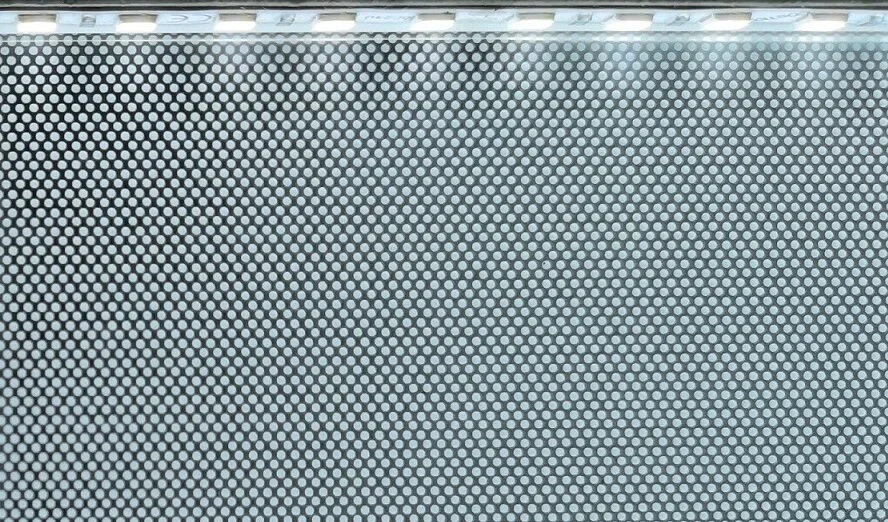
To make light leave the plate, the LGP carries an extraction pattern, printed dots, laser-engraved dots, or dispersed scattering particles in the case of a diffusive LGP. Wherever light hits a dot, total internal reflection is broken and the light scatters out through the front face. The dot density is graded across the plate, sparse near the LEDs, dense far from them, so the panel emits uniformly even though light intensity drops with distance from the edge.
The LGP never works alone. Behind it sits a white reflector film that returns downward-scattered light back into the plate, and in front sits a diffuser film that hides the dot pattern and smooths the output. Frames often add a light blocking film strip along the edges to prevent light leakage around the LED coupling zone.
How a Direct-Lit (Backlit) LED Panel Works
In a direct-lit panel, LEDs are mounted on a PCB at the back of the housing, facing forward. Light travels through an air cavity and passes through one or more diffusing layers before exiting the panel face. There is no light guide plate, the cavity depth and the diffuser do the work of spreading light.
The critical design parameter is the ratio between the optical distance (the depth from LED to diffuser) and the LED pitch (the spacing between LEDs). If the cavity is too shallow or the LEDs too far apart, each LED shows through the face as a bright spot. Designers manage this with three levers: wider-beam LED lenses, tighter LED spacing, and stronger diffusion in the front sheet. A strong diffusion sheet hides LED hotspots at shallow cavity depths, at the cost of some transmittance; a high transmission sheet maximises efficiency where the cavity is deep enough to blend light before it reaches the face.
The Optical Stack, Layer by Layer
Edge-lit stack (front to back)
- Diffuser film or sheet, hides the extraction pattern, smooths luminance. See optical diffuser films.
- Prismatic sheet (optional), controls glare angle for UGR<19 compliance in office lighting. See how opal film and prismatic lenses achieve UGR<19.
- Light guide plate, PMMA or PC, 2–10 mm typical; thin LGPs go down to 1 mm for space-constrained designs.
- White reflector film, PET or PC, recovers downward-scattered light. See reflector films.
- Light blocking film (edges), black PET masking to stop edge leakage. See light blocking films.
Direct-lit stack (front to back)
- Diffuser sheet or plate, the primary optical layer; diffusion grade chosen against cavity depth and LED pitch. See LED diffuser sheets.
- Prismatic sheet (optional), for glare control in troffers and recessed panels.
- Air cavity, typically 15–40 mm in luminaires; deeper cavities relax the diffusion requirement.
- Reflective cavity lining, white reflector film on the back and side walls raises cavity efficiency by recycling light.
- LED array on PCB, pitch and lens beam angle set the uniformity budget.
Edge-Lit vs Direct-Lit: Comparison
| Property | Edge-lit | Direct-lit (backlit) |
|---|---|---|
| Panel thickness | Very thin, 8–12 mm total is common | Thicker, cavity depth adds 15–40 mm |
| Luminance uniformity | Excellent when the dot pattern is engineered correctly | Good; depends on cavity depth, LED pitch and diffusion grade |
| Optical efficiency | Lower, coupling and guiding losses in the LGP | Higher, shorter light path, fewer interfaces |
| Component cost | Higher, LGP is the dominant cost | Lower optics cost; more LEDs may be needed |
| Weight | Higher, solid PMMA/PC plate | Lower, mostly air |
| Hotspot risk | At the coupling edge if masking is poor | Across the face if cavity/pitch ratio is wrong |
| Large sizes (>600 mm) | Needs laser-engraved dot patterns for uniformity | Scales easily, add LEDs |
| Typical uses | Slim office panels, displays, signage, appliance lighting | Troffers, high-bay, backlit ceilings, TV backlights |
Getting Uniformity Right in Edge-Lit Designs
Uniformity in an edge-lit panel is decided almost entirely by the extraction pattern. Screen-printed dot patterns suit high-volume standard sizes; laser-engraved LGPs allow the dot map to be tuned per design without printing tooling, which matters for large panels (above roughly 600 mm) where small grading errors become visible. Diffusive LGPs avoid dot patterns entirely by scattering light in the bulk of the plate, and work well for smaller panels. For the manufacturing routes behind these options, see our guide to injection molded light guide plates.
Material choice also matters: PMMA offers the highest transmittance and is the default for LGPs, while polycarbonate trades a few percent of transmittance for impact resistance and higher temperature tolerance. Our PMMA vs PC vs PS material guide covers the comparison in detail.
Getting Uniformity Right in Direct-Lit Designs
For direct-lit panels the rule of thumb is that the optical distance should be at least roughly half the LED pitch when using standard wide-beam LEDs and a medium diffusion face. When the housing must be shallower than that, move up a diffusion grade or reduce the pitch. Because stronger diffusion costs transmittance, the efficient approach is to fix the mechanical constraints first (cavity depth, LED count), then select the lightest diffusion grade that fully hides the array — not the strongest one available.
Lining the cavity with white reflector film is the cheapest efficiency gain available in a direct-lit design: a high-reflectance PET film on the back wall recycles light that would otherwise be absorbed by the housing.
Which Architecture Should You Choose?
- Slim office panels and UGR<19 luminaires — edge-lit, for the thin profile; pair the LGP with a prismatic sheet or opal film for glare control.
- Troffers, high-bay and industrial fixtures — direct-lit, for efficiency and easy scaling; depth is rarely a constraint.
- Signage and lightboxes — edge-lit for slim double-sided signs; direct-lit for large single-sided boxes where depth is available.
- Displays and instrumentation — edge-lit with thin LGPs where every millimetre counts; see also front light guide plates for E-Ink and reflective LCDs.
- Backlit stretch ceilings and luminous walls — direct-lit with strong diffusion membranes or sheets.
Sourcing the Components
Hexatron Technologies manufactures the optical components for both architectures: light guide plates (thin, diffusive and laser-engraved), LED diffuser sheets in three diffusion grades, optical films (diffuser, reflector and light blocking), and UGR<19 prism optics. For panel designs that need custom dot patterns, non-standard sizes or bonded assemblies, see custom projects.
Frequently Asked Questions
Is edge-lit or direct-lit more energy efficient?
Direct-lit is usually more efficient at the fixture level because light takes a shorter path with fewer lossy interfaces. Edge-lit panels lose several percent at the LED-to-LGP coupling and during guiding. Edge-lit wins on form factor, not efficiency.
Why do some direct-lit panels show visible LED dots?
The cavity is too shallow for the LED pitch and diffusion grade used. The fix is one of: deeper cavity, tighter LED pitch, wider-beam lenses, or a stronger diffusion sheet.
Can an edge-lit panel be made larger than 600 mm?
Yes, but uniformity becomes harder to hold with printed or bulk-diffusion plates. Large edge-lit panels normally use laser-engraved dot patterns, where the extraction map is computed for the exact geometry.
Which architecture is better for UGR<19 office lighting?
Both can comply — glare rating is set by the front optic (prismatic sheet or opal film), not by the backlight architecture. Edge-lit is the common choice because recessed office panels are thin.