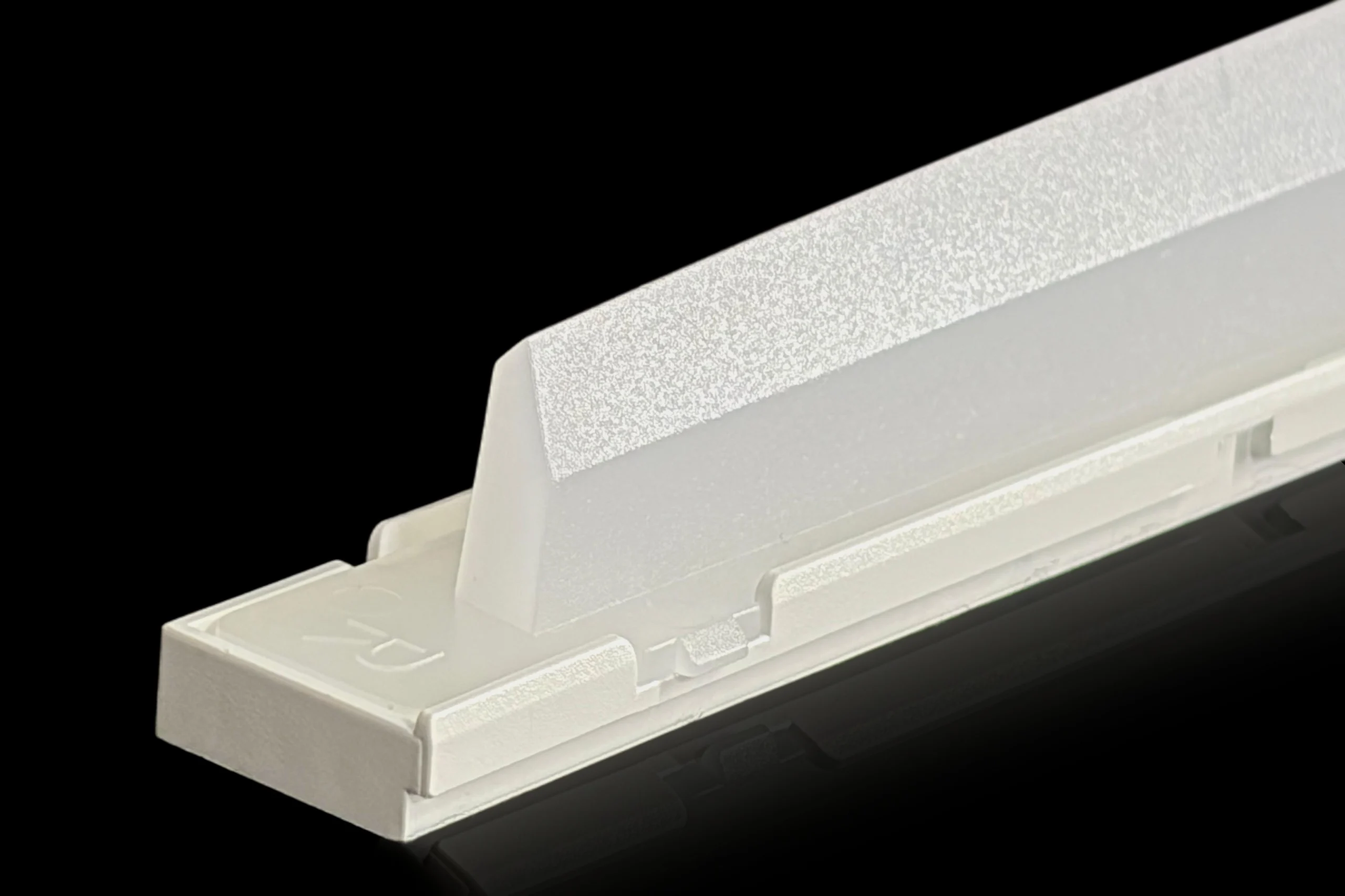
Injection Molded Light Guide Plates: Process, Tooling, and Optical Performance
A light guide plate (LGP) is the flat panel inside an edge-lit LED luminaire that spreads light evenly across its surface. If you’ve ever noticed how some LED panels glow uniformly while others show bright spots near the edges or dim patches in the middle, that difference usually comes down to how the LGP was made.
There are several ways to manufacture an LGP. Injection molding is one of the most common for medium-to-high volume production. This guide explains how it works, what to look for when sourcing injection molded LGPs, and how to decide if it’s the right route for your project, without all the jargon.
Not sure where to start? Our team is happy to help you figure out which LGP type suits your application best.
What Makes Injection Molding Different?
LGPs can be manufactured in a few different ways. Here’s a plain-English overview:
- Laser engraving (Laser LGP): Dot patterns are etched onto a flat sheet using a laser. No tooling required, patterns can be adjusted digitally for each batch. Great for custom sizes and lower volumes.
- Screen printing: Dots are printed onto a sheet with ink. Cost-effective at medium volumes, though less precise than laser or molded options.
- Injection molding: The entire LGP, including the dot pattern, is formed inside a precision mold in one step. Once the mold is made, every part that comes out of it is optically identical. That consistency is the main reason manufacturers choose this method for larger production runs.
The key advantage of injection molding is repeatability. When you’re producing hundreds or thousands of luminaires that need to look the same, having every LGP come from the same mold removes a major source of variation.
How Injection Molded LGPs Are Made (Step by Step)
Here’s a simplified breakdown of what actually happens during production:
1. Designing the Mold
The mold is where all the important decisions are locked in, the plate’s dimensions, thickness, the dot pattern that distributes light, and any mounting or edge features. Building a mold is the main upfront cost in injection molded LGP production, but once it’s ready, it can produce thousands of identical parts reliably.
A few design choices that have the biggest impact:
- Where the plastic enters the mold: The entry point must be positioned so it doesn’t leave visible marks or lines in the light-emitting area of the finished plate.
- Surface finish: The front face (where light exits) needs an optical-grade polish. The back carries the dot pattern.
- Cooling: Even cooling across the mold prevents the plate from warping — which can cause visible unevenness in the final lit panel.
2. Preparing the Material
The raw plastic pellets (either PMMA or PC — more on this below) are dried before processing. This removes any moisture that could cause tiny bubbles or surface defects in the finished part.
3. Molding the Part
Melted plastic is injected into the closed mold under controlled pressure. Pressure is held briefly as the material cools and contracts — this step fills in any small gaps that would otherwise leave surface imperfections.
4. Cooling and Release
The part cools inside the mold until it’s solid enough to be pushed out. Ejector pins are positioned carefully so they don’t leave marks on the optical surfaces you’ll see in the final luminaire.
5. Quality Check
Each batch is inspected for flatness (a warped plate won’t light evenly), surface defects, and optical uniformity — typically by measuring how evenly light is distributed across the panel surface.
PMMA or PC: Which Material Is Used?
Injection molded LGPs are made from one of two materials: PMMA (acrylic) or polycarbonate (PC). Both are optically clear, but they behave differently in use. Here’s how they compare:
| Property | PMMA | PC |
|---|---|---|
| Light transmittance | ~92% | ~88–90% |
| Refractive index | 1.49 | 1.586 |
| Processing temperature | 220–250°C | 280–320°C |
| Shrinkage | ~0.3–0.5% | ~0.5–0.7% |
| Impact resistance | Moderate | High |
| UV stability | Good (UV-stabilised grades) | Requires UV coating or stabilised grade |
| Yellowing over time | Low | Moderate without UV protection |
In plain terms: PMMA transmits more light and stays clearer over time — it’s the go-to choice for most LED panel applications. PC is the right pick when the LGP needs to handle physical impact, higher temperatures, or very thin profiles where acrylic would be too brittle.
For a more detailed comparison of these materials across optical applications, see our PMMA, Polycarbonate and Polystyrene Material Guide. If impact resistance is a concern for your application, our LED Diffuser IK Ratings guide explains how PC and PMMA compare in real-world conditions.
How the Dot Pattern Works
The dot pattern on the back of an LGP is what redirects light upward through the front surface. In injection molded LGPs, this pattern is built directly into the mold itself, so every plate comes out with an identical pattern, with no separate engraving or printing step.
Dots near the LED edge are small and sparse, there’s already plenty of light there. Moving toward the far edge, dots get larger and more densely packed to compensate for the natural drop in LED intensity. Getting this gradient right is what produces even illumination across the whole surface.
One important trade-off to know: once the mold is made, changing the dot pattern means re-machining or replacing the tool, which is costly. This is why optical simulation before finalising the mold design is an essential step.
What to Look for When Specifying an Injection Molded LGP
If you’re sourcing or specifying an injection molded LGP, here are the key parameters to define:
- Luminance uniformity: How evenly light spreads across the surface. Office and commercial panels typically require >85%; display backlights often need >90%.
- Total light output: The overall brightness of the panel, depends on material transmittance, dot pattern efficiency, and how LEDs are coupled at the edge.
- Hotspot control: The zone right next to the LEDs can appear brighter than the rest. Good mold design manages this through a dot-free zone near the LED entry edge.
- Colour consistency: For white LEDs, any variation in colour temperature across the panel is visually noticeable. Material batch consistency plays a big role here.
Not sure how to define these for your project? Our team can walk you through what to specify based on your application, reach out here.
Cost, Lead Times, and When It Makes Sense
Injection molding requires an upfront investment in tooling. This is what makes it economically different from laser or printed LGPs — but also what makes it so cost-effective at volume.
- Tooling cost: Varies with plate size and complexity. A single-cavity tool for a standard panel LGP is a significant fixed cost. Multi-cavity tools reduce per-part cost at higher volumes but require more upfront investment.
- Lead time: A new mold typically takes 4–8 weeks from design sign-off to first production run. Optical-grade tool polishing adds time compared to standard tooling.
- Minimum order quantities: MOQ is driven by tooling amortisation. Injection molding generally becomes cost-competitive with laser LGPs in the hundreds to low thousands of units per run.
Injection molding is a good fit when:
- You have consistent, ongoing production volumes
- Optical consistency unit-to-unit is important
- Your design includes edge features or mounting geometry that can be molded in one step
- Your specification is stable and unlikely to change
Other LGP manufacturing methods may suit you better if:
- You need prototype quantities or low volumes
- Your design is still being refined
- You need a non-standard plate size that doesn’t justify custom tooling
Where Injection Molded LGPs Are Used
Injection molded LGPs appear across a wide range of lighting and display products:
- LED flat panel luminaires: Office, retail, and commercial ceiling panels where visual consistency across a large installation matters
- Slim downlights and edge-lit fixtures: Where the LGP must fit precisely into a compact luminaire housing
- Backlit signage and lightboxes: Where uniform surface brightness is the primary goal
- Display backlights: Monitor and instrument displays with tight uniformity requirements — see also our guide to front-lit LGPs for E-Ink and R-LCD displays
- Medical and cleanroom lighting: Environments where material consistency and long-term colour stability are essential
- Architectural lighting: Feature and decorative lighting where the LGP is part of a visible aesthetic
Frequently Asked Questions
Is injection molding suitable for prototypes or small runs?
Generally not — the tooling cost makes injection molding most economical at medium-to-high volumes. For prototypes or designs that are still being iterated, laser-engraved LGPs are a better starting point. Patterns can be adjusted digitally between runs at no extra tooling cost. Once the design is locked and volumes justify the investment, transitioning to injection molding gives better per-part economics and optical repeatability.
PMMA or PC — which should I use?
For most LED panel applications, PMMA is the better choice — it transmits more light, resists yellowing over time, and is simpler to work with in the mold. Choose PC when the application demands high impact resistance (IK08–IK10), higher operating temperatures, or very thin profiles where PMMA would be too brittle. Our PMMA vs PC material guide covers this in more depth, or contact our team if you’d like a direct recommendation.
How does a molded dot pattern compare to laser engraving?
Both methods can achieve high optical uniformity when done correctly. The practical difference is flexibility: laser engraving lets you change the pattern per job without any tooling change; injection molding locks the pattern into the mold at the point of tool release. For volume production with a stable spec, injection molded patterns are more consistent part-to-part. If you think the pattern might need adjusting after initial production, laser engraving keeps those options open.
What information do I need to provide when sourcing an injection molded LGP?
At a minimum: plate dimensions (length × width × thickness), material preference (PMMA or PC), LED source details (wavelength, pitch, package type), luminance uniformity target, and any edge or mounting features. If you have an existing sample or optical simulation data, sharing that too significantly speeds up the tooling design process. Not sure what to specify? Our team can guide you through it.
Not Sure Which LGP Type Is Right for Your Project?
Injection molding is one of three main LGP manufacturing routes — alongside Laser LGP and Diffusive LGP. The right choice depends on your volume, how stable your design is, your optical targets, and your budget — and it’s not always obvious from the outside.
Our team works with lighting manufacturers and OEMs at all stages of product development. Whether you’re still in the prototype phase and not ready to commit to tooling, or you’re scaling up and want to understand whether injection molding makes sense for your next production run — we can help you assess the options and point you toward the right solution.
Browse our full LGP product range, explore Custom Projects for bespoke requirements, or contact our technical team to talk through your application.
Working with Hexatron on LGP Projects
Hexatron supplies optical-grade PMMA and polycarbonate materials used in LGP manufacturing, including sheet stock for laser-engraved LGPs and material for injection molding applications. Our product range covers Thin LGP, Diffusive LGP, and Laser LGP — each suited to different volume and performance requirements.
For projects moving toward injection molded production, we can assist with material selection, thickness specification, and connecting you with the right manufacturing route for your volume and optical targets. If your design is still in development, our laser LGP options provide a practical path to validated optical performance before any tooling is committed.
To discuss your LGP requirements or request samples, contact our technical team or browse our full LGP product range.
Related Resources
- What Is a Light Guide Plate (LGP)? Types, Materials & LED Use Cases — overview of LGP technology, materials, and use cases
- PMMA, Polycarbonate and Polystyrene: Material Guide for LED Diffusers and Optical Sheets — full material comparison
- LED Diffuser IK Ratings: How PS, PMMA and Polycarbonate Compare — impact resistance guide
- Front Light Guide Plate for E-Ink & R-LCD Displays — specialist display LGP applications
- Thin LGP
- Diffusive LGP
- Laser LGP
- How to Master Thermoforming with PMMA — related optical-grade PMMA processing