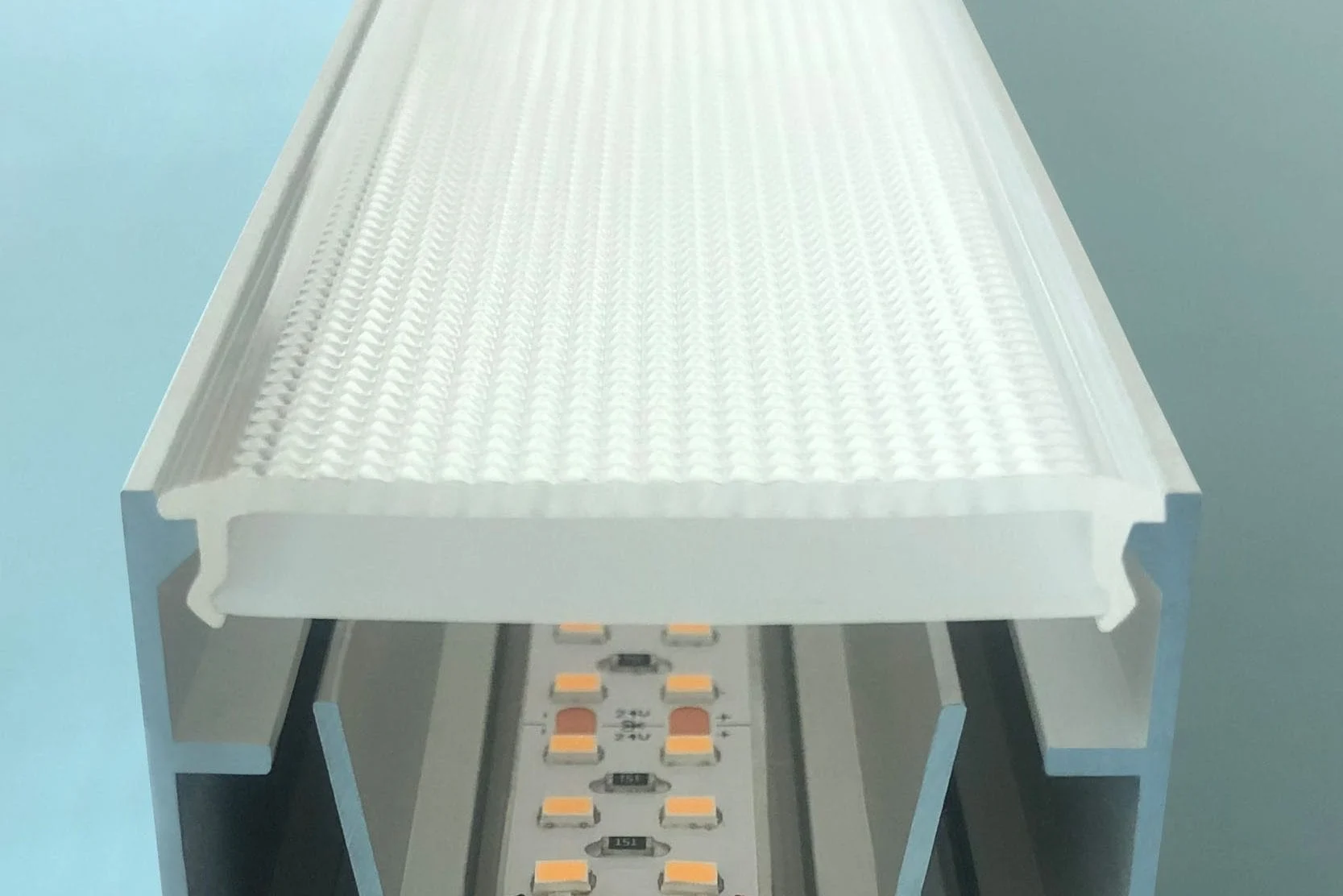
UGR<19 LED Panels: Opal Film & Prismatic Lens Solutions
Achieving a UGR<19 compliant luminaire with a smooth, uniform light effect requires precise engineering and the right combination of optical materials. Modern LED panels must balance efficiency, visual comfort, and aesthetic consistency — making the pairing of optical diffuser films and prismatic sheets essential for high-performance lighting systems.
Under EN 12464-1, a Unified Glare Rating below 19 is required for task areas such as offices, classrooms, and healthcare environments. Achieving it reliably depends on selecting the correct optical stack — not just a single component.
Understanding UGR<19
UGR (Unified Glare Rating) is the standardised measure of discomfort glare in indoor lighting. A value below 19 is required for offices, classrooms, healthcare facilities, and meeting rooms. To achieve it, LED luminaires must control beam angle, eliminate hotspots, and distribute light evenly — accomplished through a layered optical system where each material plays a specific role.
The Role of the Prismatic Diffuser Sheet
A clear prismatic sheet is the primary optical controller in any UGR<19 luminaire. Its micro-structured surface redirects light from the LED array into a controlled distribution pattern while preserving luminous efficiency.
Key functions include:
- Precise beam angle formation
- High-angle glare reduction
- Compatibility with UGR<19 design requirements
- Maintained optical efficiency
Prismatic Sheet Profiles
Prismatic sheets are available in several prism geometries, each suited to different applications and luminaire types:
Honeycomb
A convex hexagonal microstructure that provides multi-directional luminance control and 360° isotropic glare suppression. Well suited to premium architectural and office luminaires where uniform beam control from all observer positions is critical.
Hexagon
A symmetrical hexagonal pattern engineered for multi-axis glare control with reduced sparkle. A strong choice for linear lighting applications requiring consistent optical clarity across the panel face.
Pyramid
The most widely used prism design in commercial LED panels. Multi-faceted pyramidal geometry balances glare control and luminous efficiency, supports consistent UGR<19 results, and is available with standard tooling for reduced lead time and lower tooling costs.
The Role of the Optical Diffuser Film
The optical diffuser film complements the prismatic sheet by softening and blending the light produced by LEDs. Without this layer, individual LED chips remain visible as hotspots through the panel face — reducing visual comfort and breaking the uniform appearance expected in modern luminaires.
The diffuser film contributes:
- Hotspot elimination
- Smooth, uniform light output across the panel surface
- An opal or frosted aesthetic finish
- Improved visual comfort for workplaces and public spaces
How the Two Layers Work Together
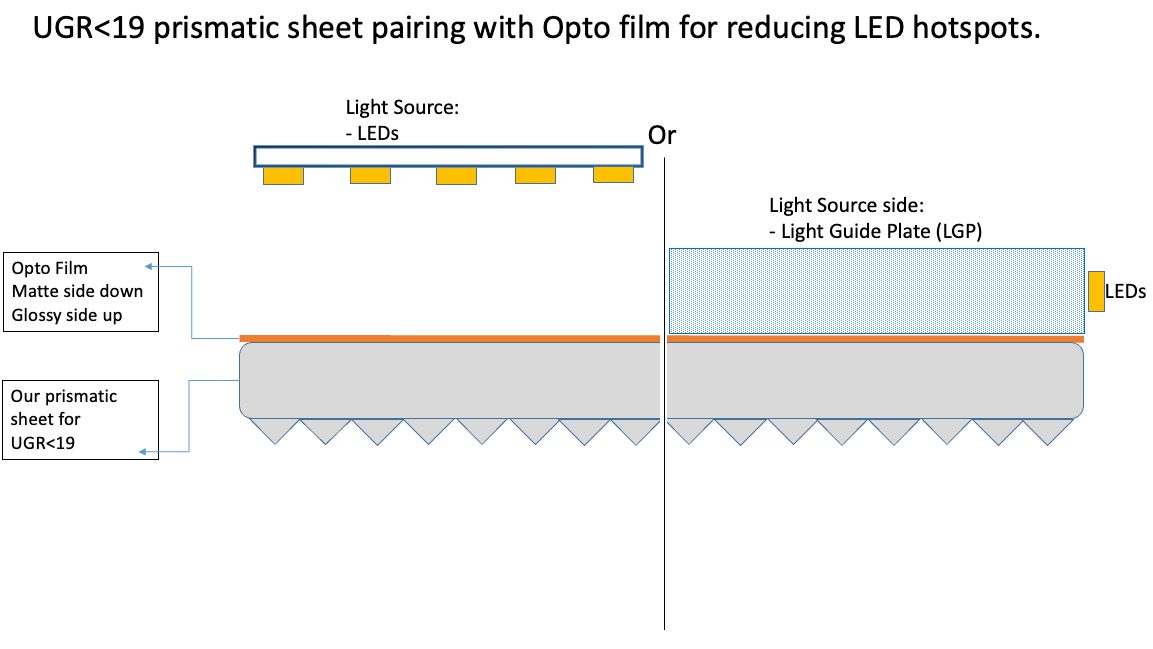
Each layer handles a distinct optical function. The prismatic sheet controls beam angle and suppresses high-angle glare; the diffuser film eliminates point-source visibility and creates the even glow associated with premium LED panels. Neither component alone reliably delivers both results.
When combined — held mechanically by the panel frame or bonded as a single unit — the result is a lighting surface that meets UGR<19 technical requirements and delivers a visually polished finish.
Recommended Material Options
At Hexatron Technologies, we supply both components optimised for UGR<19 applications:
Optical Diffuser Films
- Opto90 PET225 — High optical diffusion with excellent light transmission. Recommended for linear LED luminaires and flat panel lights.
- Opto80 PC200 — Slightly lower transmittance for stronger glare control in compact or high-output luminaires.
- Plexi90 Frost / Plexi90 Silk — Diffuser sheets delivering smooth light diffusion with a premium opal aesthetic finish.
Prismatic Sheets
- Plexi Honeycomb — Advanced hexagonal microstructure for superior multi-directional beam management and visual comfort.
- Plexi Hexagon — High optical clarity for linear and precision lighting applications.
Assembly: Mechanical vs Bonded
The diffuser film and prismatic sheet can be paired using two methods depending on luminaire design:
Mechanical Assembly
In most LED panels, both components are held in place by the frame, housing, or panel structure — no adhesive required. Components can be sourced and replaced independently. This is the standard approach for the majority of commercial luminaires.
Bonded Assembly
In some specialised luminaires, the diffuser film is bonded directly to the prismatic sheet to create a single integrated optical element. This simplifies installation and improves stability in thin-profile designs, but adds cost and makes independent replacement harder. It is not required for most standard LED panels.
Assembly in LGP-Based LED Panels
LED panels built around a Light Guide Plate (LGP) use a four-layer optical stack:
- White reflector film
- Light Guide Plate (LGP)
- Optical diffuser film
- Prismatic sheet
All layers are compressed and secured by the panel frame. Bonding between the diffuser film and prismatic sheet is generally unnecessary — the structure holds everything in alignment, and light distribution is governed by all four layers working together.
A Proven Material Combination
One of the most consistently specified optical stacks for UGR<19 panels:
Plexi Honeycomb Prismatic Sheet + Opto90 PET225 Optical Film
- Outstanding high-angle glare control
- Uniform, soft light distribution
- A premium opal diffusion effect
- Architectural-grade panel aesthetics
Typical applications: office ceiling panels, retail luminaires, architectural fixtures, and commercial indoor lighting.
Hexatron’s UGR<19 Optical Materials
At Hexatron Technologies, we supply both prismatic diffuser sheets and optical diffusion films for UGR<19 LED panel designs. Our materials are available in standard and custom dimensions, with options for mechanical supply or pre-bonded combinations depending on your assembly process.
If you are specifying a new luminaire or looking to optimise an existing panel’s optical performance, contact us to discuss your requirements or request material samples.