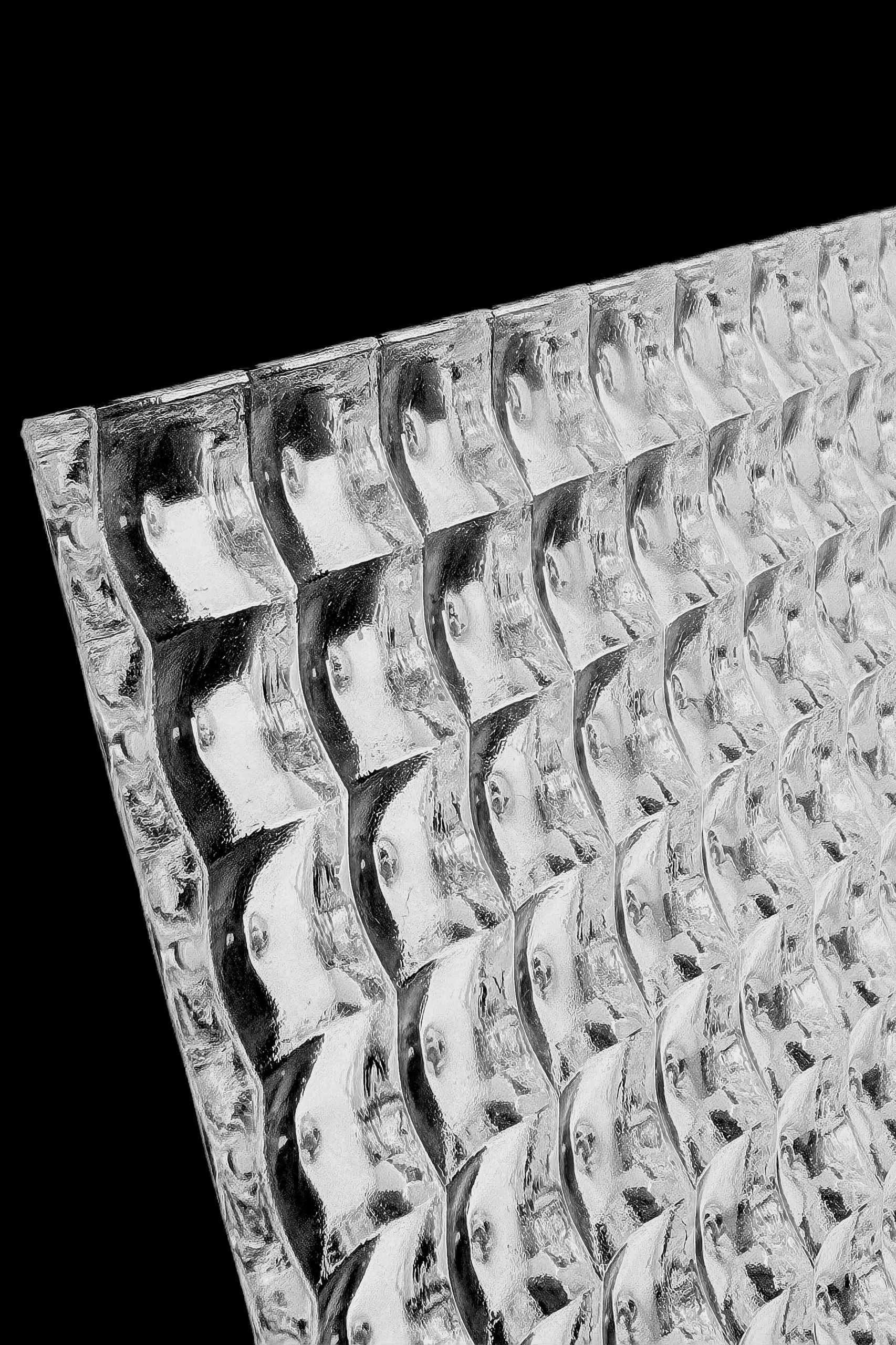
What Is a K12 Prismatic Sheet? Types, Materials & LED Applications
A K12 prismatic sheet is a large-facet optical diffuser used in recessed LED panels, troffers, high-bay luminaires, and suspended ceiling fixtures. It controls glare, distributes light broadly across the room, and keeps lumen output high — all at a lower cost than fine microprismatic geometries.
If you have sourced prismatic diffuser sheets before, you have likely encountered the naming confusion: K12, P12, Pattern 12, PL-21, KSH-12, JK-K12, Prismatic Louvre Panel, Troffer Lens Panel. Every supplier seems to use a different code for what is fundamentally the same product.
This guide explains the geometry, how the naming conventions developed, which specs to check when sourcing, which material suits your application, and where the K12 format fits in the wider prismatic product landscape.
What Is a K12 Prismatic Sheet?
A prismatic diffuser sheet is an optical plastic sheet with a structured surface — a repeating pattern of prisms extruded or embossed onto one face. When light from an LED source enters the sheet, the prism facets refract and redirect it, reducing glare and improving visual comfort in the space below.
K12 refers specifically to the large-facet variant: prism cells with a base of approximately 4–6 mm and a prism depth of 1.8–2.2 mm. This is what separates K12/P12-style sheets from microprismatic products — the prisms are large enough to be visible as a textured pattern when the fixture is lit.
The large facet geometry produces four practical characteristics:
- High transmittance — the sheet is predominantly clear, so lumen output stays high (88–92% for PMMA)
- Strong angular control — large facets redirect high-angle rays effectively, reducing direct glare from the fixture
- Wide beam spread — light is distributed broadly, which suits wide-span and high-bay applications
- Visible sparkle — the facet pattern creates a characteristic textured appearance under illumination
The Many Names for the Same Product
The naming confusion comes from three separate naming systems that developed independently in different regions.
K12 and P12 — the Industry Codes
K12 and P12 refer to the same product. K (from the German Kunststoff, meaning plastic) is the convention in European and Asian supply chains. P is the North American equivalent. Both designate a large-prism diffuser sheet approximately 2.5–3.0 mm thick with an angled female conical prism structure.
K15 / P15 is the thicker sibling — approximately 4.0–4.5 mm — with a deeper prism profile and a heavier panel weight. Used where extra rigidity is needed, such as wide-span industrial fixtures or applications with vibration.
Brand and Distributor Codes
Manufacturers and distributors have layered their own designations on top of the generic K12/P12 code:
Pattern 12 / PL-21 — Plaskolite’s designation for their OPTIX-branded large prismatic acrylic sheet. The geometry is specified as a 3/16 inch square base female conical pattern. Found at North American distributors including ePlastics, Laird Plastics, and Grainger.
JK-K12 — China Acrylic Sheet Co.’s code for their equivalent. Geometry: a 5 × 5 mm square base female conical prism on a 45° axis, giving the sheet a diamond orientation when viewed face-on.
KSH-12 — used by several European and Asian distributors.
P12A — The Lens Guys’ designation for their K12-compatible replacement sheet.
Application Names
In the commercial fit-out and replacement market, the same sheet is described by application rather than code:
Troffer Lens Panel / Troffer Prismatic Lens — the dominant term in North America. A troffer is a recessed ceiling luminaire; when a facility manager orders a troffer lens replacement, they almost always mean a K12/P12 sheet.
Prismatic Louvre Panel — common in UK and Australian specification documents.
2×4 Prismatic Light Panel / 2×2 Prismatic Light Panel — dimensional descriptions used by online retailers and replacement part distributors.
Fluorescent Light Cover Panel — legacy terminology from the fluorescent era that persists in the retrofit and replacement market.
Standard Prismatic Sheet — generic term used by general plastic distributors.
Large Prism Diffuser — increasingly used as LED retrofits have expanded the K12/P12 market beyond fluorescent applications.
Large Prism vs Microprismatic: Which Do You Need?
Both product types use prismatic geometry, but they solve different problems. Choosing the wrong one is a common and costly mistake.
| Property | Large Prism (K12 / P12) | Microprismatic (Honeycomb, Hexagon) |
|---|---|---|
| Facet size | Large (4–6 mm+) | Fine (0.5–2 mm) |
| UGR performance | Typically UGR 20–25 | UGR < 19 achievable |
| Light transmittance | High (88–92%) | Slightly lower |
| Visual appearance | Sparkle / visible texture | Smooth, low sparkle |
| Best applications | Warehouses, industrial, retail | Offices, healthcare, schools |
| Cost | Lower | Higher |
If your project specifies EN 12464 UGR < 19 compliance, a microprismatic sheet — or a K12 sheet paired with a diffuser film — is the correct route. For applications where lumen output and cost-efficiency matter more than strict UGR compliance, the large prismatic geometry is the right choice.
Key Specifications to Check When Sourcing
Not all K12 / P12 sheets perform the same. When requesting samples or data sheets, focus on these numbers:
Light transmittance — target 88% or above for PMMA, 85%+ for PC. Every percent below target represents measurable lumen loss at fixture level.
Haze — expect 85–92% for a large prismatic. Higher haze improves LED hot-spot masking; very high haze shifts the appearance toward an opal diffuser.
Prism depth — 1.8–2.2 mm is typical for K12/P12. Shallower prisms from low-cost sheets reduce angular control noticeably.
Prism pitch — the centre-to-centre spacing between prism cells. Inconsistent pitch across a sheet is a sign of poor process control.
Thickness — standard K12/P12 is 2.5–3.0 mm. K15/P15 is 4.0–4.5 mm. Undersized thickness causes panel sag in wide-span frames.
Flammability rating — UL 94 HB is standard for PMMA and PS. UL 94 V-0 is available in PC. TP(a) rigid classification (required in UK/EU commercial projects) requires polycarbonate with a flame-retardant additive package.
UV stability — critical for fixtures near windows or any UV source. PMMA has natural UV stability; PS and PC benefit from UV stabiliser additives.
Need a sample or data sheet for your next project? → Request one from Hexatron Technologies
Materials: PMMA, PC, or PS?
PMMA (Acrylic) delivers the highest light transmittance and the best long-term colour stability. It is the standard choice for commercial office, retail, and ceiling panel applications. Note: PMMA has the highest thermal expansion coefficient of the three materials — for large panels, factor in dimensional changes across the operating temperature range before finalising your frame design.
PC (Polycarbonate) is the material for demanding environments. Shatter-resistant, suitable for industrial facilities, sports halls, and any application where impact is a risk. PC achieves UL 94 V-0 and TP(a) ratings with flame-retardant additives — which PMMA cannot. Higher cost than PMMA, but significantly lower replacement frequency in tough conditions.
PS (Polystyrene) is the lowest-cost option. Suitable where replacement cycles are short and the environment is benign. More prone to yellowing over time without UV stabilisers, and similar impact resistance to PMMA (low). Not recommended for long-term installations.
Applications for K12 Prismatic Sheets
Warehouses and logistics centres — high-bay LED luminaires at 8–14 m need efficient downward light delivery. K12 prismatic sheets redirect light efficiently while reducing direct glare at the vertical viewing angle.
Retail spaces — wide, even illumination with high transmittance supports lux levels on merchandise. The sparkle characteristic of large prism sheets is also visually effective in retail environments.
Industrial and manufacturing — PC-based K12 sheets handle vibration, occasional impact, and elevated ambient temperatures that would crack PMMA over time.
Open-plan offices (non-UGR < 19 spec) — where UGR < 19 compliance has not been specified, K12 sheets deliver good visual comfort at lower cost than microprismatic alternatives.
Troffer retrofit and replacement panels — a large share of K12/P12 demand is replacement panels for 2×2 and 2×4 recessed ceiling fixtures being converted from fluorescent to LED. The K12 geometry fits most standard troffer frame sizes and is the default replacement specification.
Schools and public buildings — corridors, sports halls, and utility areas where robust construction and long lumen maintenance are the priority.
The Plexi Prism508 from Hexatron Technologies
The Plexi Prism508 is Hexatron Technologies’ large prismatic sheet — a direct-compatible alternative for projects currently specifying K12, P12, Pattern 12 / PL-21, JK-K12, KSH-12, P12A, or any Troffer Lens Panel to this geometry.
| Specification | Value |
|---|---|
| Prism geometry | Large-facet angled female conical |
| Available materials | PMMA, PC, PS |
| Standard thickness | 2.5–3.0 mm (K12 equivalent) |
| Light transmittance (PMMA) | 88–92% |
| Standard width | 1220 mm (up to 1250 mm on request) |
| Standard lengths | 1220 / 1830 / 2440 / 3050 mm |
| Thickness tolerance | ±3% |
| Cut-to-size tolerance | ±0.3 mm |
| Flammability (PMMA/PS) | UL 94 HB |
| Flammability (PC) | UL 94 V-0 (with FR additives) |
| Certifications | REACH, RoHS, PFAS-free |
Custom processing available: cut-to-size, CNC machining, laser cutting (up to 1300 × 1300 mm), bonding, edge finishing.
→ View the Large Prisms product page and request a data sheet
Frequently Asked Questions
Is K12 the same as P12? Yes. K12 and P12 are regional naming conventions for the same large-prism diffuser geometry. K is standard in Europe and Asia; P is standard in North America. Performance between compliant sheets from different suppliers should be equivalent.
What is Pattern 12 / PL-21? Pattern 12 and PL-21 are Plaskolite’s (OPTIX brand) product codes for their large prismatic acrylic sheet. The geometry is a 3/16 inch square base female conical prism — the direct equivalent of K12/P12.
What is the difference between K12 and K15? K15 (also P15) is the thicker variant — approximately 4.0–4.5 mm versus 2.5–3.0 mm for K12. The deeper prism profile adds rigidity and slightly stronger angular control. Used in applications requiring a heavier panel, such as industrial fixtures with vibration.
Can a K12 sheet achieve UGR < 19? Not on its own. The large facet geometry typically produces UGR values of 20–25. To reach UGR < 19, pair the sheet with a diffuser film, or switch to a microprismatic geometry such as a honeycomb or hexagonal prismatic sheet.
What fire rating is available for K12 prismatic sheets? PMMA and PS are typically UL 94 HB. Polycarbonate achieves UL 94 V-0 with flame-retardant additives. For UK and EU commercial projects requiring TP(a) rigid classification, a PC sheet with the appropriate additive package is required.
What is a Troffer Lens Panel? Troffer Lens Panel (also Troffer Prismatic Lens or 2×4 Prismatic Light Panel) is the functional term used in the North American replacement market for a K12/P12 prismatic sheet cut to standard troffer frame dimensions. A troffer is a recessed ceiling luminaire; the lens panel is the prismatic diffuser covering the light source.