Opal Diffuser Sheets for LED Lighting: Acrylic, Polycarbonate and Polystyrene Compared
An opal diffuser sheet is a white, translucent optical sheet that turns the point-source glare of LEDs into a smooth, even glow. Opal diffusers are the most widely specified diffuser type in lighting, used in ceiling panels, linear luminaires, signage, and backlit surfaces, yet the differences between grades and materials are often reduced to “how white it looks”. This guide explains what actually makes a diffuser opal, how to read the transmittance–haze trade-off, which base material to choose, and when an opal sheet is the right optic versus a prismatic one.
What Makes a Diffuser “Opal”?
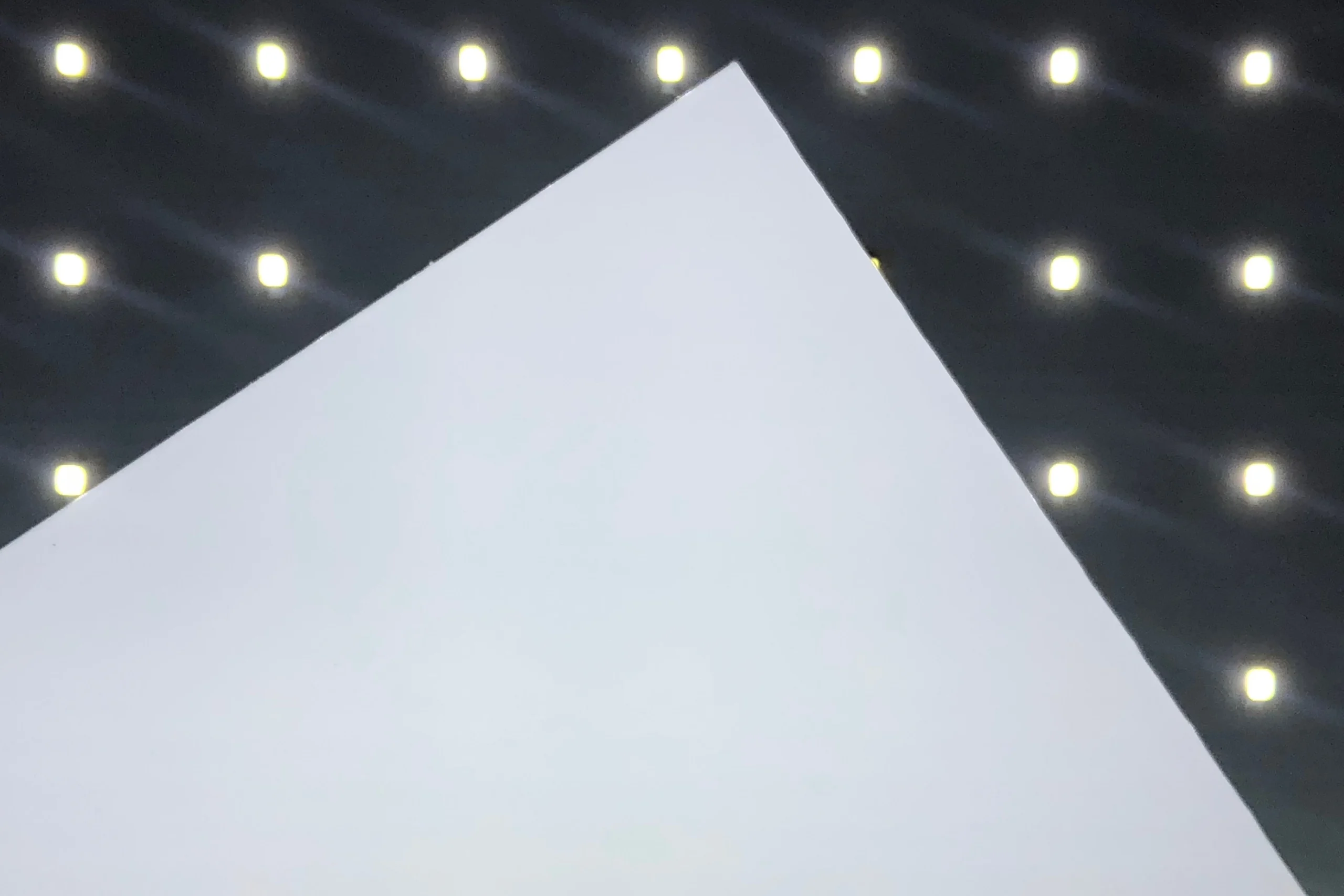
Opal diffusion is volumetric: light-scattering particles are dispersed through the full thickness of the sheet during compounding, and every particle boundary bends light in a new direction. By the time light exits the front face, its original direction is fully randomised, which is why a well-specified opal sheet shows no LED hotspots and no imaging of what sits behind it.
This differs from surface-textured (frosted or matte) sheets, where scattering happens only at the face and hiding power is much weaker, and from diffuser films, which apply the same principle in thin, flexible PET or PC formats rather than rigid sheets.
The Transmittance–Haze Trade-off
The two numbers that define an opal diffuser are total light transmittance (how much light gets through) and haze (how completely the light is scattered). They pull against each other: more scattering particles mean better hiding power but lower transmission. Every opal grade is a chosen point on that curve.
| Grade | Typical character | When to specify it |
|---|---|---|
| High Transmission | Highest light output, moderate hiding power | Deep housings where light blends before the face; efficiency-critical designs |
| Medium Diffusion | Balanced output and hiding power | General ceiling panels and linear luminaires with standard optical distance |
| Strong Diffusion | Complete LED hiding at shallow depths, lowest transmission | Slim fixtures, tight LED pitch, backlit surfaces viewed up close |
The efficient way to specify is to fix the mechanical design first — optical distance and LED pitch — then choose the lightest grade that fully hides the array. Over-specifying diffusion wastes lumens; the same logic applies in direct-lit panel design, where the diffuser grade and cavity depth are chosen together.
Material Choice: PMMA, Polycarbonate or Polystyrene
Opal grades exist in all three common optical plastics, and the base resin decides everything the scattering particles don’t:
- Opal PMMA (acrylic) – the optical benchmark: highest transmittance, best UV stability, holds its white point for years outdoors or under UV-rich sources. Moderate impact resistance.
- Opal polycarbonate – the durability choice: virtually unbreakable, higher temperature tolerance, and available in flame-retardant grades for fixtures that must meet fire classifications. Slightly lower transmittance; needs UV-protective capping outdoors.
- Opal polystyrene – the economy choice for indoor, low-stress applications such as troffer lenses and suspended-ceiling panels, where cost per square metre dominates.
The full property comparison, impact strength, fire ratings, UV and thermal behaviour, is covered in our PMMA vs polycarbonate vs polystyrene material guide. For vandal-prone or public installations, check the IK impact rating comparison; for fixtures with fire-classification requirements, flame-retardant opal grades are available through our high performance materials range.
Opal vs Prismatic: Which Optic Do You Need?
Opal sheets and prismatic sheets solve different problems. Opal scatters light in all directions, ideal for a soft, uniform appearance, but it sends some light toward high viewing angles where it registers as glare. Prismatic optics use refracting facets to redirect light downward, which is how UGR<19 office panels control glare, and how K12 prismatic sheets handle troffers and high-bay fixtures.
- Choose opal when uniform luminance and appearance matter most: signage, backlit surfaces, decorative and architectural fixtures, wallwashers.
- Choose prismatic when glare angle control matters most: office lighting to EN12464, screen-work environments, deep industrial spaces.
- Combine them when you need both: a diffused prismatic pairs a prism structure with opal-style diffusion so the LED array is hidden and the glare angles are controlled in one sheet.
Thickness, Formats and Fabrication
Rigid opal sheets typically run from 1.5 mm to 4 mm for luminaire lenses, with thicker plates used for large signage faces that must stay flat. Practical points when specifying:
- Thickness and hiding power interact: A thicker sheet of the same compound hides better but transmits less; grade and thickness should be chosen together, not separately.
- Cutting: Opal PMMA and PS cut cleanly by saw or laser; polycarbonate should be sawn or routed rather than laser-cut.
- Forming: Opal PMMA thermoforms well into curved and domed diffusers; see our guide to thermoforming with PMMA.
- Expansion gaps: Like all thermoplastics, opal sheets grow with temperature; frame designs should allow clearance, which you can size with our thermal expansion calculator.
Applications
- Ceiling panels and troffers, medium diffusion opal as the standard lens; strong diffusion for slim retrofit kits.
- Linear and pendant luminaires, opal PMMA or PC lenses, flat or formed.
- Illuminated signage and lightboxes, opal acrylic faces with even luminance across large spans.
- Backlit ceilings, walls and furniture, strong diffusion grades viewed at close range.
- Hygiene-critical environments, chemical-resistant opal grades for hospital and cleanroom fixtures.
- Dark-face designs, where the fixture should look dark when off, a black diffuser replaces the white opal face.
Sourcing Opal Diffuser Sheets
Hexatron Technologies manufactures opal diffuser sheets in all three diffusion grades through the LED Diffuser Sheets series, in PMMA, polycarbonate and polystyrene, with custom cutting to size. Prism-plus-diffusion combinations are available as Diffused Prismatics, and non-standard geometries, formed parts, or bonded assemblies run through Custom Projects.
Frequently Asked Questions
What is the difference between opal and frosted acrylic?
Opal acrylic scatters light throughout its volume via dispersed particles, giving strong hiding power. Frosted acrylic only scatters at its textured surface, it softens reflections but will not hide LED hotspots at close range.
What transmittance should an opal diffuser have?
There is no single right number, it depends on the optical distance to the LEDs and the pitch of the array. Specify the highest-transmittance grade that fully hides the LEDs in your actual housing geometry, and validate with a sample before committing to volume.
Is opal polycarbonate or opal acrylic better for LED lighting?
Opal PMMA transmits more light and resists UV yellowing better; opal polycarbonate is far more impact resistant and offers flame-retardant grades. Indoors with no impact risk, PMMA is the usual default; for public, vandal-prone, or fire-classified fixtures, polycarbonate earns its premium.
Can opal diffusers achieve UGR<19?
Not on their own, opal diffusion spreads light into high angles rather than controlling them. UGR<19 compliance comes from prismatic or micro-prismatic optics, either alone or combined with opal diffusion in a diffused prismatic sheet.