LED Diffuser IK Ratings: How PS, PMMA and Polycarbonate Compare
When specifying LED lighting, most decisions centre on lumens, colour temperature, and energy efficiency. The diffuser rarely gets the same consideration until it cracks, yellows, or shatters. Understanding the IK rating of an LED diffuser is one of the most practical steps in any lighting specification, because it determines how well the fixture survives in the real world.
The diffuser sits at the interface between the LED source and the space it illuminates. It softens the raw output of the LED diode, but it also serves as the fixture’s first line of physical protection. The IK rating quantifies how much impact that protection can absorb.
Selecting the right material, Polystyrene, PMMA, or Polycarbonate, shapes both the optical and mechanical performance of the finished fitting. This guide walks through how each material performs on impact resistance, light transmittance, and UV stability, and how to match those properties to the demands of a specific application.
Decoding the IK Rating: What the Numbers Actually Mean
Before we analyse the materials, we need to understand the scale used to measure them. In the world of durability, “strong” is too vague. We need precision. Enter the IK Rating.
Defined by international standards (IEC 62262), the IK rating measures the degree of protection provided by enclosures for electrical equipment against external mechanical impacts. In simpler terms: how hard can you hit this light fixture before it breaks?
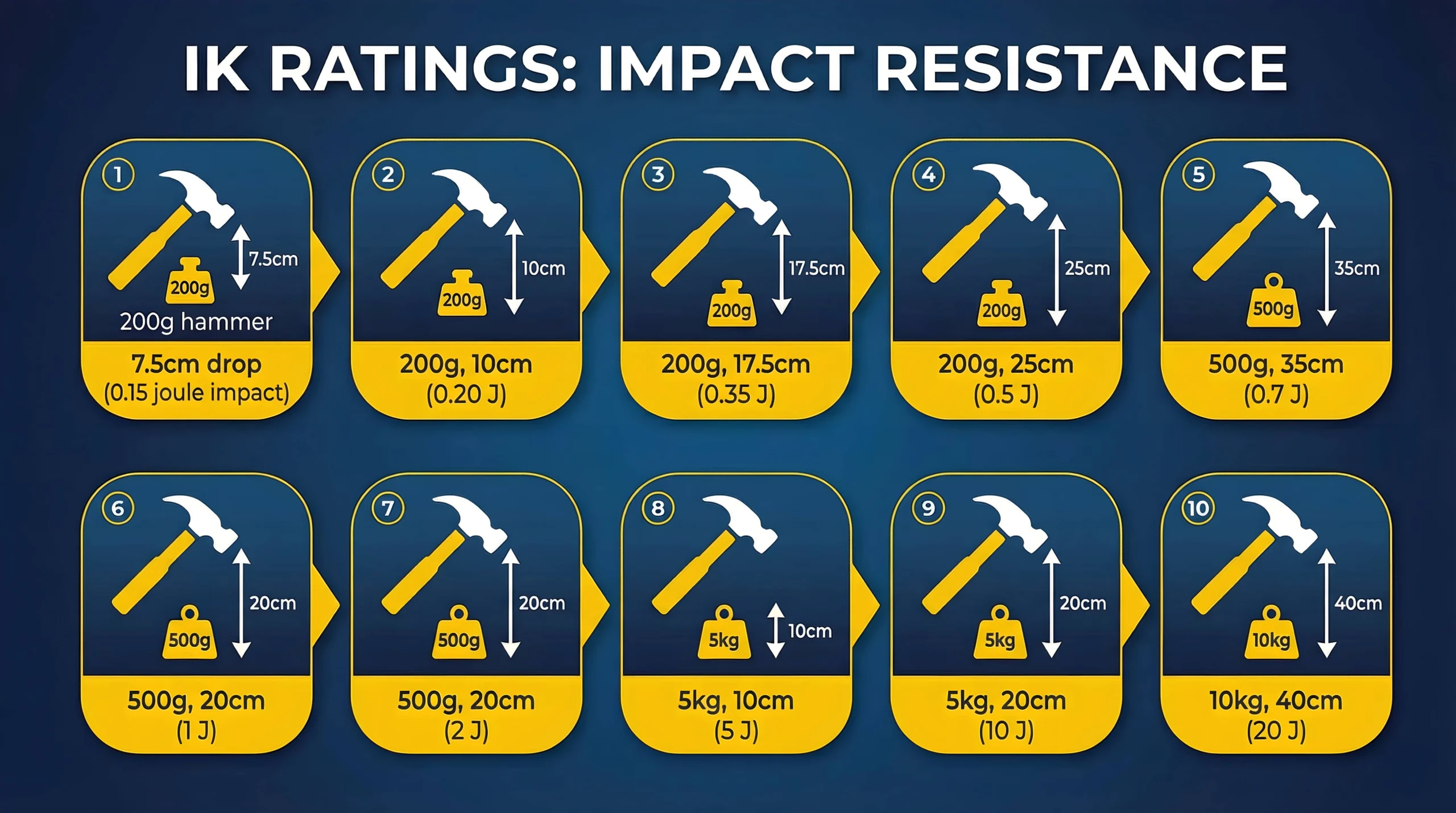
The scale ranges from IK00 (no protection) to IK10 (maximum protection). It is a logarithmic scale, meaning the jump from one level to the next represents a significant increase in required resistance.
- IK00: No protection.
- IK01 to IK05: Protected against impacts less than 1 Joule. (A very light knock during routine cleaning.)
- IK06: Protected against 1 Joule impact. (Comparable to a 500g object falling from 20cm.)
- IK07: Protected against 2 Joules. (A common standard for general office or educational environments.)
- IK08: Protected against 5 Joules. (The typical threshold for vandal-resistant lighting in public areas.)
- IK10: Protected against 20 Joules. (Comparable to a 5kg mass dropped from 40cm — the maximum rating for high-risk, industrial, or public transport applications.)
Why does this metric matter? Because it directly relates to the long-term integrity of the fixture. If you are lighting a subway station, a gymnasium, or a factory floor, you aren’t just looking for light — you are looking for reliability and IK10 compliance.
The IK rating achieved depends not just on the fixture housing but crucially on the material of the diffuser. Here is how the three most common plastics compare on impact resistance.
Polystyrene (PS) Diffusers: The Budget-Friendly Option
If you walk into a standard office building with simple panel lights or recessed troffers, you are likely looking at Polystyrene (PS). It is the entry-level standard for bulk LED diffusion.
The Material Profile
Polystyrene is widely used because it is the most economical material to manufacture and easy to mold or thermoform into large sheets. It offers decent light transmission and effectively diffuses LED hotspots, creating the smooth, milky illumination associated with general lighting.
The IK Reality: Low Durability
When it comes to mechanical impact resistance, PS is the weakest link among the common diffuser materials.
- Typical IK Rating: IK02 to IK04.
- Behaviour: PS is rigid but inherently brittle. Under stress or sudden impact, it does not flex or deform — it snaps or shatters into sharp, potentially hazardous pieces. Even careless handling during installation can cause damage.
Best Use Case: Budget-sensitive projects where the light is installed high out of reach, and areas with no foreseeable risk of physical impact.
PMMA (Acrylic) Diffusers: The Champion of Optical Performance
Stepping up in quality and performance from Polystyrene, we arrive at Polymethyl Methacrylate, commonly known as PMMA or Acrylic. In the lighting industry, PMMA is valued primarily for its optical properties.
The Material Profile
PMMA is often cited as the closest plastic equivalent to glass. It offers exceptional clarity and the highest light transmission of the three materials, making it the preferred choice when maximising lumens per watt is a priority. PMMA is also naturally UV stable, which means it resists the yellowing that affects PS over time — a quality PMMA diffuser maintains its clarity and colour over its entire service life. It is also well suited to thermoforming into custom diffuser shapes, making it a versatile option for bespoke luminaire designs.
The IK Reality: The Middle Ground
PMMA is harder and stiffer than Polystyrene, offering improved resistance to light knocks and scratches. It provides a moderate improvement in durability but is still considered a material where optical performance takes priority over physical toughness.
- Typical IK Rating: IK06 to IK07.
- Behaviour: A diffuser of 1.5mm thickness can withstand minor bumps and general wear, but similar to glass, it is prone to cracking or shattering when subjected to sharp, focused, or high-energy impacts.
There are specialist versions, such as High-Impact Modified PMMA, which incorporate rubberised compounds to increase flexibility. These variants can push the rating closer to IK08, but standard Acrylic remains best suited for environments where optical clarity and UV stability are prioritised over brute strength.
Best Use Case: High-end architectural lighting, retail spaces, museums, hospitals and cleanrooms, and any environment where optical performance, maximum light output, and long-term non-yellowing are the primary design factors.
Polycarbonate (PC) Diffusers: The Heavyweight King of Impact Resistance
If PMMA is the “glass” of the plastic world, Polycarbonate (PC) is the “steel.” When a lighting specification calls for “vandal-resistant,” “shatterproof,” or “industrial grade” housing, the answer is almost exclusively Polycarbonate.
The Material Profile
Polycarbonate is an amorphous thermoplastic renowned for its toughness, often exceeding the tensile strength of many metals. It is the same polymer used in riot shields, aircraft canopies, and bulletproof windows. While its natural light transmission is slightly lower than PMMA (around 88–89%), modern prismatic and diffusion additives have helped narrow this gap considerably, allowing it to perform well optically while maintaining its structural integrity. PC diffusers are also subject to fire safety certification (GWFI) requirements alongside their impact rating — an important consideration for public installations.
The IK Reality: Maximum Protection
This is the area where PC fundamentally differentiates itself. It absorbs large amounts of energy by deforming plastically (bending and flexing) rather than failing catastrophically.
- Typical IK Rating: IK08, IK09, and IK10.
- Behaviour: Our PC diffuser starting at 1mm thickness is virtually unbreakable in standard lighting applications. You can often strike a high-IK PC lens with a hammer, resulting only in a dent or surface scratch, without compromising the enclosure’s integrity or shattering the material.
Best Use Case: Public transport hubs, car parks, prisons, schools, gymnasiums, street lighting, food processing facilities, hazardous industrial areas, and any location where the fixture may be subjected to accidental damage or deliberate physical abuse.
Material Comparison: IK Rating, Transmittance & UV Stability
Here is how the three main diffuser materials compare across the key performance dimensions for LED lighting specification:
| Material | Typical IK Rating | Light Transmittance | UV Stability | Best Application |
|---|---|---|---|---|
| Polystyrene (PS) | IK02–IK04 | 85–92% | Low (yellows over time) | Budget interior fixtures out of reach |
| PMMA (Acrylic) | IK06–IK07 | 88–93% | Excellent (naturally UV stable) | Architectural, retail, medical |
| Polycarbonate (PC) | IK08–IK10 | 86–90% | Good (UV-stabilised grade) | Public spaces, industrial, vandal-resistant |
The Design Conundrum: Balancing IK Ratings, Efficiency, and Glare Control
Choosing the right diffuser is not just about picking the highest number on the IK chart. Modern lighting design requires balancing protection (IK) against performance (Transmission) and visual comfort (UGR). Over-specifying one can compromise the others.
The Glare Factor (UGR)
In office, educational, and medical environments, lighting must not only be bright and durable but also visually comfortable. The Unified Glare Rating (UGR) scale measures the discomfort caused by light fixtures. A UGR value below 19 is mandatory for tasks requiring concentration (such as computer work). Diffusers play a critical role here. Standard opal diffusers soften light but can be inefficient at glare control, which has driven the development of prismatic diffusers for UGR<19 compliant panels.
Prismatic diffusers use a pattern of miniature prisms on the surface to refract and redirect the light. This geometry pushes the light downward, increasing efficiency, and cuts off the high-angle light that causes glare, thereby achieving low UGR figures.
Application: Achieving the Balance in Commercial Lighting
Leading manufacturers, such as Hexatron Technologies, specialise in solving this design challenge by offering a range of prismatic diffusers that manage all three factors simultaneously:
- Glare Control: Hexatron’s entire range of prismatic diffusers is engineered to consistently achieve a UGR < 19 rating, making them compliant with the most stringent commercial and office lighting standards.
- PMMA Prismatic Options: For installations where visual clarity, non-yellowing, and moderate durability are key, they offer PMMA prismatic diffusers rated to IK06 and IK07. This is the right specification for premium office interiors where impacts are rare but optics are critical.
- Polycarbonate Prismatic Options: For applications requiring the highest level of protection, they provide UV-stabilised Polycarbonate prismatic diffusers rated to IK09 and IK10. This combination delivers the required UGR < 19 comfort while offering maximum vandal-resistance for spaces like schools, sports halls, or utility tunnels.
This demonstrates that the trade-off between optical performance and physical toughness is no longer a harsh compromise. By employing prismatic technology, engineers can select the IK rating necessary for the environment without sacrificing visual comfort or energy efficiency.
Matching the Right Material to Your Application
There is no single “perfect” plastic, but there is always a right plastic for a specific application. Modern lighting standards require a view that integrates mechanical protection with optical performance.
- Choose Polystyrene (PS) only if the budget is the primary constraint, and the lights are installed high out of reach where impact is not a consideration.
- Choose PMMA (Acrylic) if visual clarity, maximum light output, and long-term resistance to yellowing are the priorities, and physical impact is unlikely.
- Choose Polycarbonate (PC) if the fixture is in a public space, an industrial site, or anywhere where durability is non-negotiable — with IK10 being the standard for true vandal-resistance.
By understanding the relationship between material properties, the IK rating, and the requirements for UGR, you can ensure that a lighting installation doesn’t just perform well on day one — it stays safe, bright, and intact for years to come.