TP(a) Fire Ratings for Prismatic Diffusers: PC and PS Compared
When specifying prismatic diffusers for commercial, educational, or public buildings, most engineers focus first on UGR<19 glare compliance. The TP(a) fire rating carries equal weight under UK Building Regulations — and specifying the wrong classification can prevent a product from being installed in the intended space at all.
This post explains what TP(a) rigid means, where it is required, and how our Polycarbonate (PC) and Polystyrene (PS) prismatic diffusers performed in independent SGS laboratory testing.
What is TP(a) Rigid?
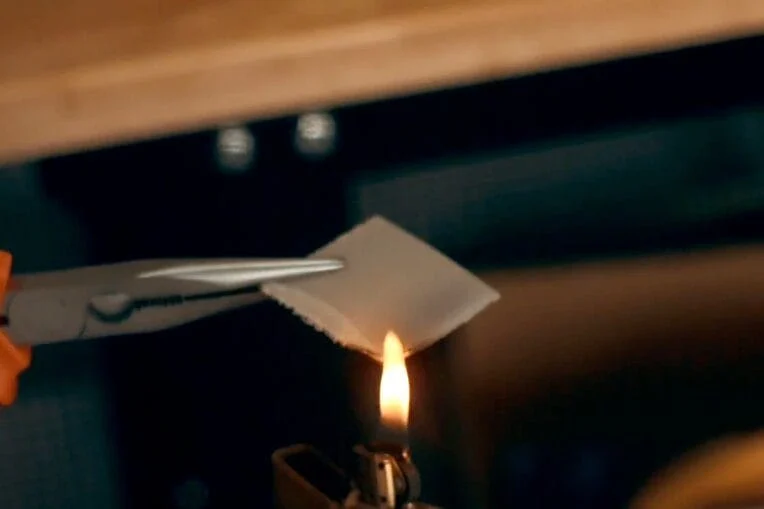
Under the Building Regulations 2010, Approved Document B (Fire Safety), thermoplastic materials used in lighting diffusers are classified based on their burning behaviour when tested to BS 2782-0:2011 Method 508A.
TP(a) rigid is the highest classification available for thermoplastic lighting diffusers. A material qualifies if it meets either of the following criteria during testing:
- The test flame extinguishes before reaching the first mark (25mm), or
- The duration of flaming or afterglow does not exceed 5 seconds following removal of the burner.
TP(a) vs TP(b): What Changes in Practice
The UK Building Regulations recognise two thermoplastic classifications for lighting diffusers. The differences between them directly affect where and how a luminaire can be installed:
| TP(a) Rigid | TP(b) | |
|---|---|---|
| Maximum individual panel size | No restriction | 5m² |
| Minimum separation between panels | No restriction | 3m |
| Protected corridors and stairwells | Permitted | Not permitted |
| Typical materials | Polycarbonate, fire-retardant PS | Standard (non-fire-retardant) PS |
For most commercial and institutional projects — offices, schools, hospitals, retail spaces — TP(a) rigid is the only workable classification. The panel size and spacing restrictions that apply to TP(b) materials are rarely compatible with standard ceiling layouts, and TP(b) is not permitted in protected corridors or stairwells at all.
Full installation requirements are set out in Approved Document B (Fire Safety).
SGS Test Results: How Our Materials Performed
Hexatron’s prismatic diffusers were independently tested by SGS to BS 2782-0:2011 Method 508A. We tested two materials: Polystyrene in a special fire-retardant grade, and standard Polycarbonate. Both achieved an official classification of TP(a) rigid.
Polystyrene (PS) — Fire-Retardant Grade
Standard Polystyrene does not meet TP(a) criteria. Hexatron’s S-Series uses a specially formulated fire-retardant PS grade that does. The material retains the optical clarity and cost efficiency that PS is known for, while meeting the stricter fire classification requirements for commercial installations.
Result: The flame front did not exceed the 25mm mark during testing.
Polycarbonate (PC)
Polycarbonate achieves TP(a) rigid through its inherent material properties — no fire-retardant additives are required. During testing, the PC samples produced the strongest result of the two materials.
Result: The flame did not reach the 25mm mark, and 0 seconds of afterflame or afterglow were recorded after the burner was removed.
Choosing Between PC and PS
Since both materials achieve TP(a) rigid, the fire classification alone does not determine which to specify. The decision comes down to the mechanical and optical requirements of the installation:
| Polycarbonate (PC) | Fire-Retardant PS | |
|---|---|---|
| TP(a) Rigid | Yes | Yes |
| Light Transmittance | 86–90% | ~90%+ |
| Impact Resistance | IK08–IK10 | IK02–IK04 |
| Best suited for | Schools, sports halls, car parks, public transport | Offices, retail, low-impact environments |
If the installation also requires impact resistance, Polycarbonate covers both requirements within the same material — it combines TP(a) fire classification with IK08 to IK10 impact ratings. If the priority is maximum light transmission in a lower-risk environment, the fire-retardant PS grade is the more efficient optical solution.
Note that both materials also carry documented Glow-Wire Flammability Index (GWFI) ratings. Some luminaire certifications (CE, ENEC) require GWFI compliance alongside TP(a), so it is worth checking both when preparing a specification.
Available Configurations
Both the Poly Series (PC) and S-Series (fire-retardant PS) are available beyond the standard honeycomb prismatic format, while maintaining TP(a) fire classification throughout:
- Prism profiles: Honeycomb, Hexagonal, Micro-Hexagon, Pyramid
- Transmission levels: from 50% diffusion through to near-clear
This means you can match the optical profile required for a UGR<19 compliant luminaire while staying within the TP(a) classification — no compromise on either the safety or the lighting performance side of the specification.