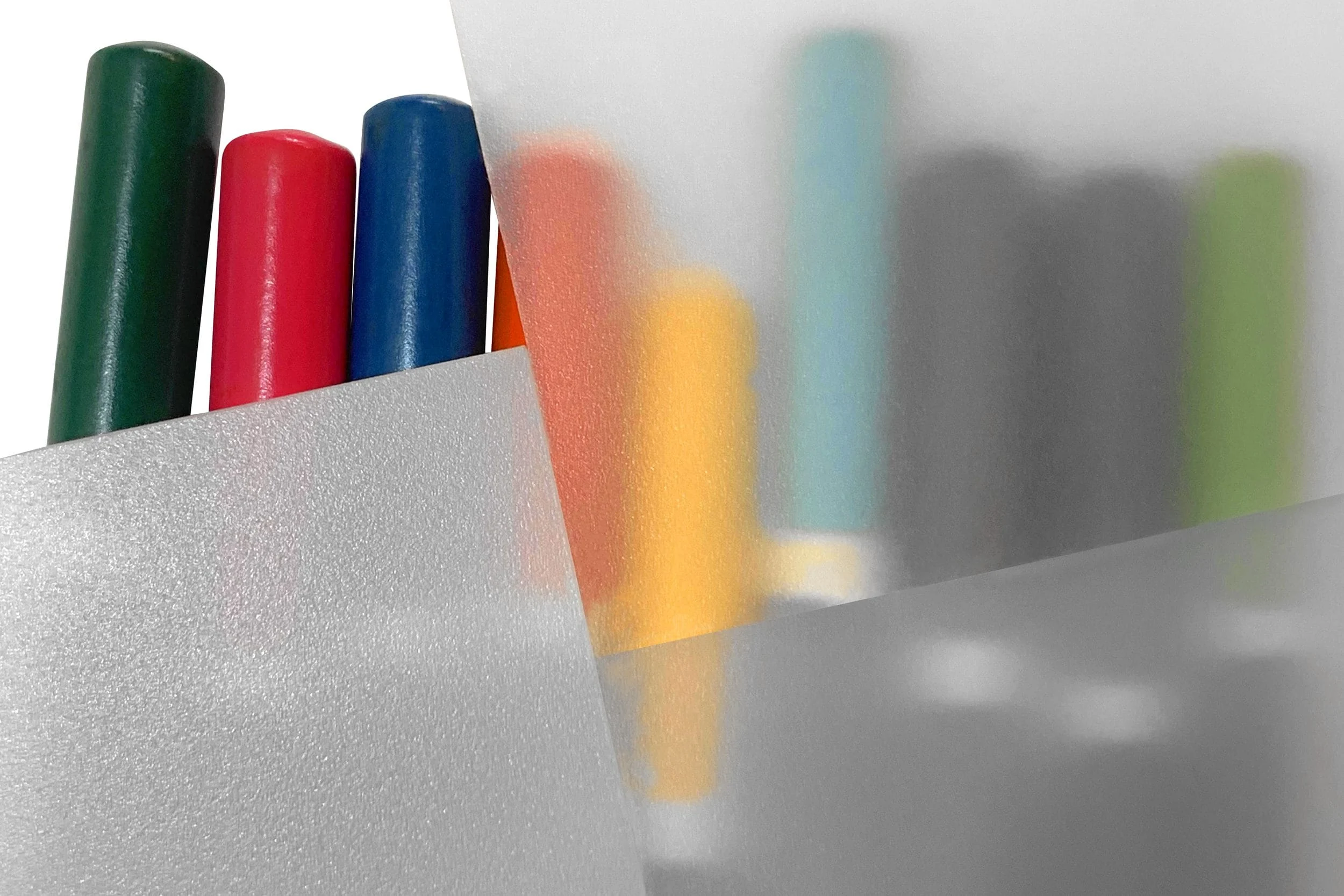
PMMA, Polycarbonate and Polystyrene: Material Guide for LED Diffusers and Optical Sheets
Why Material Choice Comes Before Every Other Optical Spec
Before you specify transmittance, haze level, prismatic pattern, or diffusion grade, there is a more fundamental question: which base material; PMMA (acrylic), polycarbonate (PC), or polystyrene (PS); is right for your application?
All three plastics are used to manufacture LED diffuser sheets, prismatic optics, light guide plates, and reflector components. At a glance they look similar: clear, rigid, available in sheets, and optically functional. But their properties diverge significantly across impact resistance, fire behaviour, UV stability, temperature range, chemical resistance, and cost. Choosing the wrong material means either over-engineering (paying for PC where PS would do) or under-engineering (specifying PS in an environment that demands PC). This guide gives you the full picture in one place, with direct links to the deeper technical articles where relevant.
At a Glance: PMMA vs PC vs PS Comparison Table
| Property | PMMA (Acrylic) | Polycarbonate (PC) | Polystyrene (PS) |
|---|---|---|---|
| Light Transmittance | ~92% (highest) | ~88–90% | ~88–92% |
| Refractive Index | ~1.49 | ~1.586 | ~1.59 |
| Haze (standard grade) | Very low (<1%) | Low | Low–moderate |
| Impact Strength (Izod) | ~20–25 kJ/m² | ~600–800 J/m (very high) | Low (brittle) |
| IK Rating Capability | Up to IK07 | Up to IK10 | IK04–IK05 |
| Glass Transition Temp (Tg) | ~100–105°C | ~145–150°C | ~95–100°C |
| Thermal Expansion (CLTE) | ~70–77 × 10⁻⁶/°C | ~65–70 × 10⁻⁶/°C | ~60–80 × 10⁻⁶/°C |
| UV Resistance (without additives) | Excellent (naturally stable) | Poor (yellows without UV stabiliser) | Poor (yellows relatively quickly) |
| GWFI (IEC 60695-2-12) | 650–750°C | 960°C (highest grade) | 650–750°C |
| TP(a) Fire Classification | Achievable in FR grades | Yes (standard PC) | Yes (SGS-certified) |
| UL94 Flame Rating | HB (V-2 / V-0 with FR) | V-0 achievable | HB standard |
| Chemical Resistance | Moderate | Poor (stress cracking risk) | Poor |
| Thermoformability | Excellent | Good (higher temp required) | Good |
| Relative Cost | Medium | High | Low |
| Density | ~1.19 g/cm³ | ~1.20 g/cm³ | ~1.04–1.06 g/cm³ |
Values are typical for optical-grade sheet materials. Exact figures depend on formulation, grade, and manufacturer. FR and UV-stabilised variants alter some properties.
PMMA (Acrylic) – In Depth
Optical Properties
PMMA achieves the highest light transmittance of the three materials at around 92%, making it the default choice where optical efficiency is the primary concern. Its refractive index of ~1.49 is lower than PC and PS, which matters in light guide plate design, a lower refractive index means a larger critical angle, allowing more efficient total internal reflection (TIR) and better side-to-face light coupling in edge-lit configurations.
Standard optical-grade PMMA also has very low intrinsic haze (<1%), which gives it exceptional clarity. Diffuser grades are produced by incorporating diffusing particles or surface texturing, but the base material’s optical quality means less additive loading is needed to hit a target haze value compared to PS.
Mechanical and Thermal Properties
PMMA is stiffer than PC and easier to machine cleanly, but it is more brittle under concentrated impact, a sharp blow will crack it where PC would flex. For LED diffuser panels in accessible or public-area luminaires, this brittleness matters: see the full IK rating comparison for PS, PMMA, and PC to understand the practical impact resistance differences.
Its glass transition temperature of around 100–105°C is adequate for most indoor luminaire operating temperatures, but PMMA’s thermal expansion coefficient is the highest of the three (~70–77 × 10⁻⁶/°C). In large-format panels and LGPs, this expansion must be accounted for in the housing design to prevent bowing, cracking, or edge-binding. Hexatron’s PMMA thermal expansion calculator lets you predict linear growth for any sheet size and temperature delta.
Fire and Compliance
Standard PMMA is rated UL94 HB (horizontal burn) and typically achieves a GWFI of 650–750°C. It can meet TP(a) rigid classification for UK Building Regulations in flame-retardant formulations, but standard-grade PMMA usually falls under TP(b). For applications in escape routes and public buildings where TP(a) is mandatory, PC or a certified FR-PMMA formulation must be specified. FR-PMMA grades are available but add cost and can affect optical transmittance slightly.
PMMA is inherently PFAS-free, RoHS-compliant, and does not require halogenated additives for UV stability, a meaningful advantage in environments with strict chemical compliance requirements such as medical devices and food-adjacent installations.
Thermoforming
PMMA thermoforms exceptionally well at temperatures between 150°C and 180°C, holding fine surface detail with good dimensional accuracy on cooling. It is the go-to material for custom-shaped diffuser shells, luminaire covers with compound curves, and moulded LGP panels. A detailed guide to thermoforming PMMA for precision optical applications covers temperature control, tooling considerations, and common defects.
Where PMMA Excels
- Light guide plates: edge-lit panels, backlit signage, display BLUs
- High-efficiency diffuser sheets where every percent of transmittance matters
- Thermoformed custom diffuser shells and covers
- Cleanroom and medical luminaires (chemical resistance and PFAS-free profile)
- Outdoor architectural lighting with UV-stabilised grades
Where PMMA Falls Short
- High-impact or vandal-risk environments (IK08+), use PC
- Applications requiring TP(a) without FR additives, use standard PC
- Very high operating temperatures (>90°C sustained), PC’s higher Tg is safer
Polycarbonate (PC) – In Depth
Optical Properties
Optical-grade PC achieves around 88–90% light transmittance, slightly lower than PMMA, but still excellent for the vast majority of luminaire applications. Its higher refractive index (~1.586) means more pronounced light bending at interfaces, which is why PC is often preferred for structured optical elements like TIR lenses and prismatic sheets where angular redirection is more important than raw throughput.
PC is also available in optically diffusing, prismatic, and micro-prismatic grades that are widely used in UGR<19 compliant panels. The small transmittance penalty compared to PMMA is rarely limiting in these applications.
Mechanical Properties: The Impact Advantage
PC’s defining characteristic is impact resistance. Its Izod impact strength of 600–800 J/m is 20–30 times higher than PMMA and orders of magnitude above standard PS. In practice, PC sheets can absorb blows that would shatter PMMA or PS without cracking. This makes PC the only viable choice for IK08, IK09, and IK10 rated luminaires, vandal-resistant fittings, outdoor bollards, transit and transport lighting, sports hall luminaires, and any installation where physical abuse is a risk.
The full technical breakdown of IK ratings across PS, PMMA, and PC covers what each IK level means in joule energy terms and which material achieves which rating.
Thermal Properties
PC’s glass transition temperature of ~145–150°C is significantly higher than both PMMA and PS. This matters in high-power luminaires, downlights with poorly managed thermal paths, and enclosed or recessed fittings where the diffuser panel can reach elevated temperatures during operation. PC provides a larger safety margin against thermal distortion and deformation than either alternative.
Fire and Compliance
PC is the strongest performer on fire safety of the three. It achieves a GWFI of 960°C under IEC 60695-2-12, the highest measurable level, and is self-extinguishing, meaning it stops burning when the ignition source is removed. It achieves TP(a) rigid classification under UK Building Regulations without requiring FR additives, making it the default specification for escape routes, corridors, stairwells, and public buildings under Approved Document B.
PC also achieves UL94 V-0 in many grades, and flame-retardant PC formulations are available for applications requiring full IEC compliance without compromise. For a detailed technical review of GWFI ratings and what they mean for luminaire safety approval, see the guide to GWFI in LED diffusers. The TP(a) comparison between PC and PS prismatic diffusers covers the specific fire test data in detail.
UV Resistance: The Caveat
PC yellows under prolonged UV exposure if not stabilised. Unlike PMMA, which is inherently UV-stable, PC requires UV-absorbing additives or co-extruded UV protective layers for outdoor or high-UV-exposure use. UV-stabilised PC grades are standard in the market, so this is manageable, but it must be specified deliberately. Un-stabilised PC should never be used in outdoor or UV-intensive applications.
Chemical Resistance: Another Caveat
PC has poor resistance to many common solvents and certain cleaning agents. Contact with acetone, aromatic solvents, some alcohols, or harsh alkaline cleaners can cause stress cracking, hazing, or rapid degradation. In hospital and cleanroom environments where frequent disinfection cleaning is required, material compatibility must be verified. For these environments, see the guide to hospital and cleanroom diffusers, which covers chemical resistance alongside optical and hygienic requirements.
Where PC Excels
- Vandal-resistant and high-impact luminaires (IK08, IK09, IK10)
- Escape routes and public buildings requiring TP(a) — no FR additives needed
- High operating temperature environments (>100°C sustained near diffuser)
- High-bay and industrial fittings requiring both optical performance and robustness
- Prismatic and micro-prismatic UGR<19 optics for commercial interiors
Where PC Falls Short
- Applications where maximum optical transmittance is critical (LGP, high-efficiency backlight)
- Budget-sensitive commodity diffuser production, PS is significantly cheaper
- Environments with strong solvent or cleaning agent exposure (verify grade compatibility)
Polystyrene (PS) – In Depth
Optical Properties
General-purpose polystyrene achieves 88–92% transmittance depending on formulation and grade. Standard PS has a refractive index of ~1.59, close to PC, which makes it suitable for prismatic and structured optical geometries. Its optical behaviour in diffuser applications is well-established, PS prismatic sheets have been the mainstream choice for commercial office lighting for decades, primarily because of their low cost and good light distribution performance at scale.
Mechanical Properties — The Impact Limitation
Standard PS is brittle. It has low Izod impact strength and will crack or shatter under loads that PMMA or PC would survive. High-impact polystyrene (HIPS) is toughened with rubber particles but this reduces clarity, making HIPS unsuitable for optical applications. For LED diffusers and optical sheets, general-purpose PS (GPPS) is used, and its low impact resistance is the primary constraint on where it can be deployed.
PS is appropriate for IK04–IK05 level applications: standard suspended ceiling panels, recessed office luminaires in controlled environments, and any installation where the diffuser is not reachable or exposed to physical risk. It should not be specified for pendant luminaires in public spaces, sport and leisure lighting, or any application where accidental or deliberate impact is a realistic possibility.
Thermal Properties
PS has the lowest Tg of the three at ~95–100°C. This is adequate for most indoor office and commercial luminaire applications where the diffuser panel does not exceed 70–80°C in operation. In downlights, high-power LED fixtures, or enclosed housings with poor thermal management, PS may warp or distort over time. Thermal analysis of the luminaire operating temperature should be conducted before specifying PS in anything other than standard panel luminaires.
Fire and Compliance
Standard PS is rated UL94 HB. Importantly, PS prismatic diffusers can achieve TP(a) rigid classification under UK Building Regulations — Hexatron’s SGS-certified test results confirm this for specific sheet formats. This means PS is a legitimate material choice for commercial and public building luminaires where TP(a) is required, provided the certified product is used. See the full TP(a) fire ratings comparison between PC and PS prismatic diffusers for the test methodology and what it means in practice.
PS is not inherently self-extinguishing in the way PC is, and its GWFI of 650–750°C is lower than PC’s 960°C. For the most demanding fire safety requirements, GWFI 960, UL94 V-0, applications in close proximity to ignition sources — PC is the safer specification.
UV Resistance
Like PC, standard PS has poor UV resistance and yellows under prolonged UV exposure. UV-stabilised grades exist but must be specified for outdoor or UV-intensive applications. Indoor commercial luminaires with no direct UV exposure are the natural home for PS.
Cost Advantage
PS is the lowest-cost optical plastic of the three, typically 30–50% cheaper than PMMA and significantly cheaper than PC on a per-sheet basis. For high-volume commercial luminaire production where the application requirements are well within PS’s capabilities, this cost difference is commercially meaningful at scale.
Where PS Excels
- Standard suspended ceiling panels and recessed office luminaires
- High-volume commercial luminaire production where cost drives specification
- UGR<19 prismatic applications in standard indoor environments
- Applications where TP(a) certification is required at minimum cost
Where PS Falls Short
- Any application requiring IK06 or above, use PMMA or PC
- High operating temperature environments, use PC or PMMA
- Outdoor, UV-exposed, or high-humidity environments — specify UV-stabilised grade or switch to PMMA/PC
- Applications requiring GWFI 960 — use PC
Choosing by Application
| Application | Recommended Material | Reason |
|---|---|---|
| Standard office recessed ceiling panels | PS or PMMA | PS for cost; PMMA where higher transmittance or better longevity is needed |
| Hospital and cleanroom luminaires | PMMA (or verified PC grade) | Chemical resistance to disinfectants; see cleanroom diffuser guide |
| Escape routes and public corridors (TP(a) mandatory) | PC or certified PS/TP(a) | PC achieves TP(a) without FR additives; certified PS also qualifies |
| Vandal-resistant or high-impact (IK08+) | PC | Only PC reliably achieves IK08–IK10; see IK rating guide |
| Light guide plates (edge-lit panels) | PMMA | Highest transmittance, best TIR efficiency, excellent thermoformability |
| High-bay and industrial warehouse lighting | PC | Combines GWFI 960, TP(a), and impact resistance for harsh environments |
| Outdoor architectural lighting | UV-stabilised PMMA or UV-stabilised PC | PMMA for best clarity and natural UV stability; PC where impact is also a factor |
| Thermoformed custom diffuser shells | PMMA | Best thermoformability and surface detail retention |
| Display backlighting (consumer electronics) | PMMA | Maximum transmittance and optical uniformity for display-grade applications |
| Sports and leisure facilities | PC | Impact resistance against balls and equipment is the dominant requirement |
| Retail and decorative pendant luminaires (public) | PC | Combines optical quality with robustness for accessible fixtures |
| Budget commercial production at scale | PS | Lowest material cost where PS capabilities meet the full spec requirement |
How Surface Finish Affects the Trade-offs
All three materials are available with diffusing surface treatments, micro-prismatic textures, matte finishes, and anti-scratch hardcoats. The base material comparison above is for standard clear grades. A few surface-finish interactions are worth noting:
- Anti-scratch coatings on PC, standard PC scratches relatively easily. Hardcoated PC is significantly more scratch-resistant and is specified for luminaires in high-traffic environments.
- Diffuser particles in PMMA, because PMMA starts with such high base transmittance, diffusing grades maintain good efficiency even with significant diffusion loading. PMMA diffuser sheets are frequently specified where both opal appearance and high efficacy are needed simultaneously.
- Prismatic patterns in PS vs PC, both materials are used extensively for prismatic UGR<19 sheets. PS is the standard choice for commodity office lighting; PC is chosen where additional fire or impact performance is needed alongside the prismatic optics.
Compliance and Safety: What to Check Before You Specify
Material selection intersects with several compliance frameworks that apply to luminaire components in different markets and applications:
- GWFI (IEC 60695-2-12) — required for luminaires where the diffuser is in the fire containment path. PC at 960°C gives the most headroom. Full technical background in the GWFI guide for LED diffuser applications.
- TP(a) / TP(b) fire classification (UK Building Regulations) — TP(a) is mandatory for many suspended ceiling and escape-route applications. Both PC and certified-grade PS can qualify. See the TP(a) comparison for test data.
- RoHS, REACH, and PFAS-free requirements — all three base materials can be formulated as RoHS and REACH compliant. FR additives and UV stabilisers must be checked individually. The complete compliance guide for RoHS, REACH, and PFAS-free LED diffusers covers what to verify and request from suppliers.
- IK impact rating (EN 62262) — the IK level defines whether PS, PMMA, or PC is appropriate. If the required IK level is not stated in the project spec, it is worth asking — many specifiers omit it until after material selection, which leads to costly late-stage changes.
Summary: Which Material Should You Specify?
Specify PMMA when optical efficiency is the primary driver — particularly for light guide plates, display backlighting, thermoformed custom parts, and high-efficiency diffuser sheets. PMMA’s natural UV stability and clean chemical profile also make it the right choice for medical and cleanroom-adjacent applications. Account for its higher thermal expansion in large panels.
Specify PC when the application demands impact resistance (IK06 and above), inherent fire performance (GWFI 960, TP(a) without additives), or operation at elevated temperatures. PC costs more than PS but eliminates the need for FR additives in fire-rated applications and provides a long service life in demanding environments. UV-stabilise it for any outdoor use.
Specify PS when the application is a standard indoor commercial luminaire — recessed ceiling panels, suspended office fittings, UGR<19 prismatic sheets in non-impact environments — and cost is a meaningful factor. PS with TP(a) certification covers the fire requirement for most commercial UK and European interior applications. Avoid PS where impact risk, elevated temperature, or UV exposure is present.
Hexatron’s Optical Sheet Range
Hexatron supplies diffuser sheets, prismatic optics, and high-performance optical materials across all three base materials, with SGS-certified fire test data and full compliance documentation available on request.
- LED Diffuser Sheets — PMMA and PC grades in high transmission, medium diffusion, and strong diffusion
- High Performance Material — flame-retardant, thermal-stable, scratch-resistant optical-grade sheets
- Light Guide Plates (LGP) — optical-grade PMMA in thin, diffusive, and laser-engraved formats
- Custom Projects — bespoke sheet cutting, thermoforming, and optical component manufacturing to specification
If you are working from a spec and need to confirm which material and grade matches your application, contact the team via the Custom Projects page with your requirements.