Mikroprismen
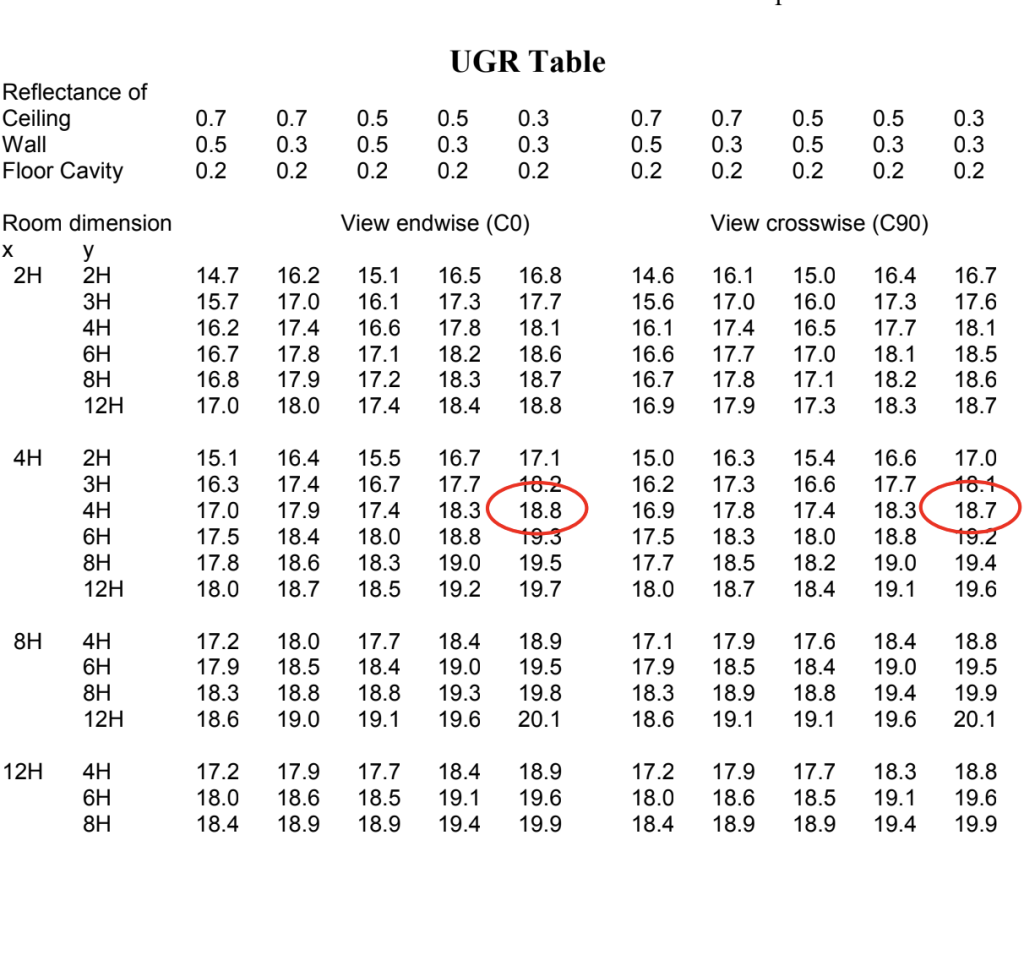
La serie Mikroprismen Convex Micro Hexagon está diseñada para luminarias compactas que requieren un control preciso del deslumbramiento y una alta eficiencia óptica. Su geometría de prismas hexagonales a microescala logra un UGR < 19 manteniendo una apariencia de luminancia uniforme, incluso con distancias reducidas entre el LED y la óptica.
- Estabilidad en láminas finas: Geometría robusta para ópticas delgadas y paneles de gran tamaño.
- Reducción de la pixelación: Los microprismas mezclan las fuentes LED para una salida de luz más limpia.
- Corte de ángulos altos: Las facetas convexas redirigen los rayos de ángulo alto (>65°).
- Uniformidad isotrópica: Brillo constante desde todas las direcciones.
- Alta eficiencia: Pérdida de luz mínima en comparación con los difusores convencionales.
Certificaciones

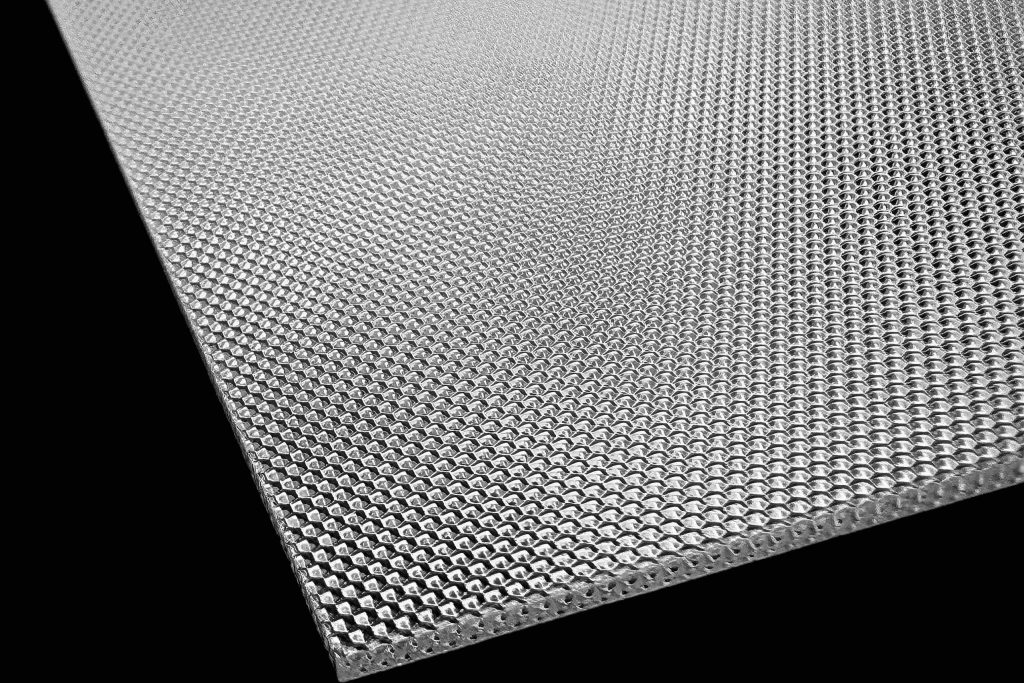
Comparativa de productos
| Product Code | Material | Thickness mmin | Light Transmission | Fire Rating | Key Features | Thickness in mmin |
|---|---|---|---|---|---|---|
| Plexi Mikroprismen | Acrylic (PMMA) | 1.5 | 94% | UL94 HB | Optical clarity, high transmission, uniform luminance. | 0.059 |
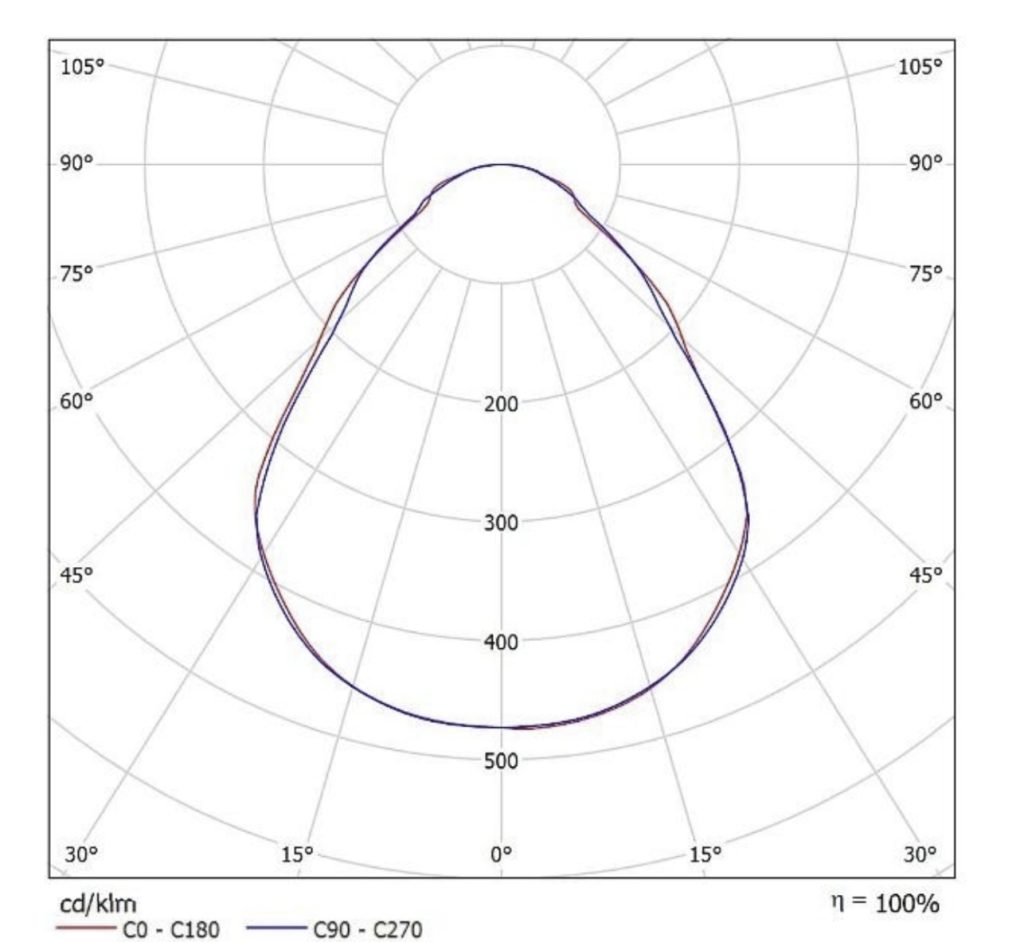
Datos fotométricos
Rendimiento óptico y refracción
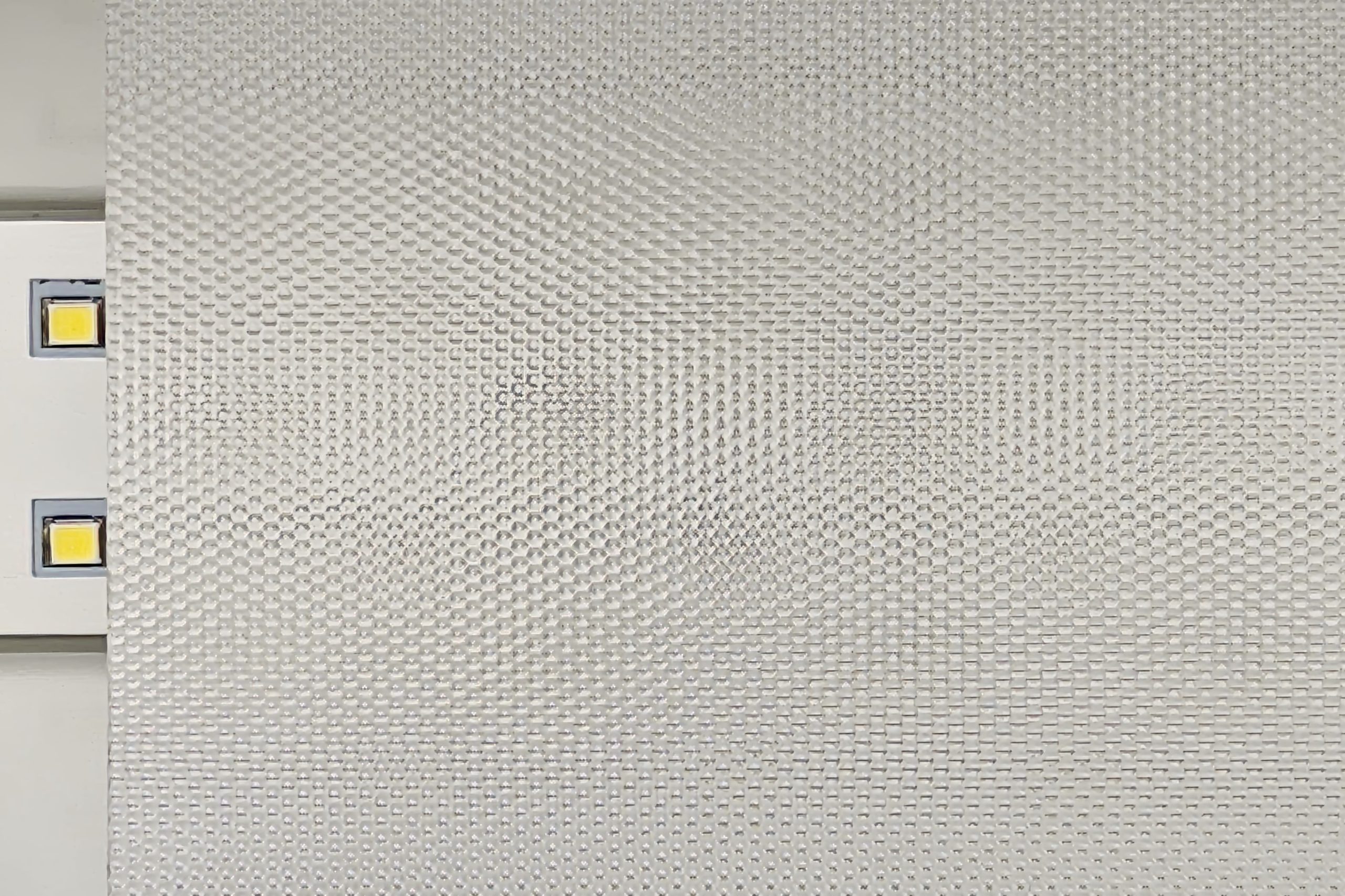
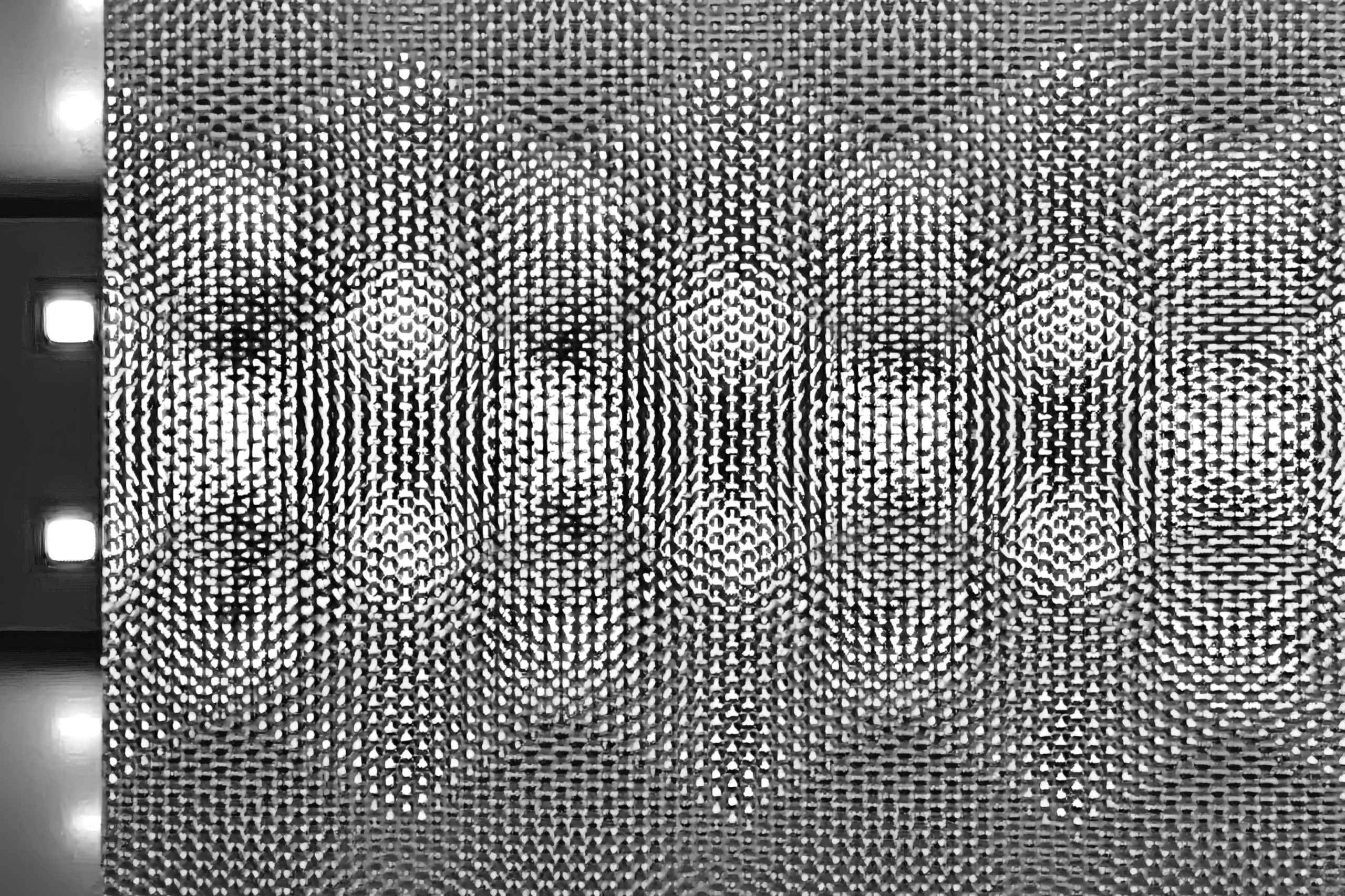
Activación geométrica
Observe cómo los microprismas hexagonales se “activan” bajo la iluminación. Cada microcelda convexa captura la emisión bruta del LED y la refracta en un plano de trabajo suave y uniforme, mezclando las matrices de LED densas y suprimiendo el deslumbramiento de ángulo alto para lograr un rendimiento UGR < 19.
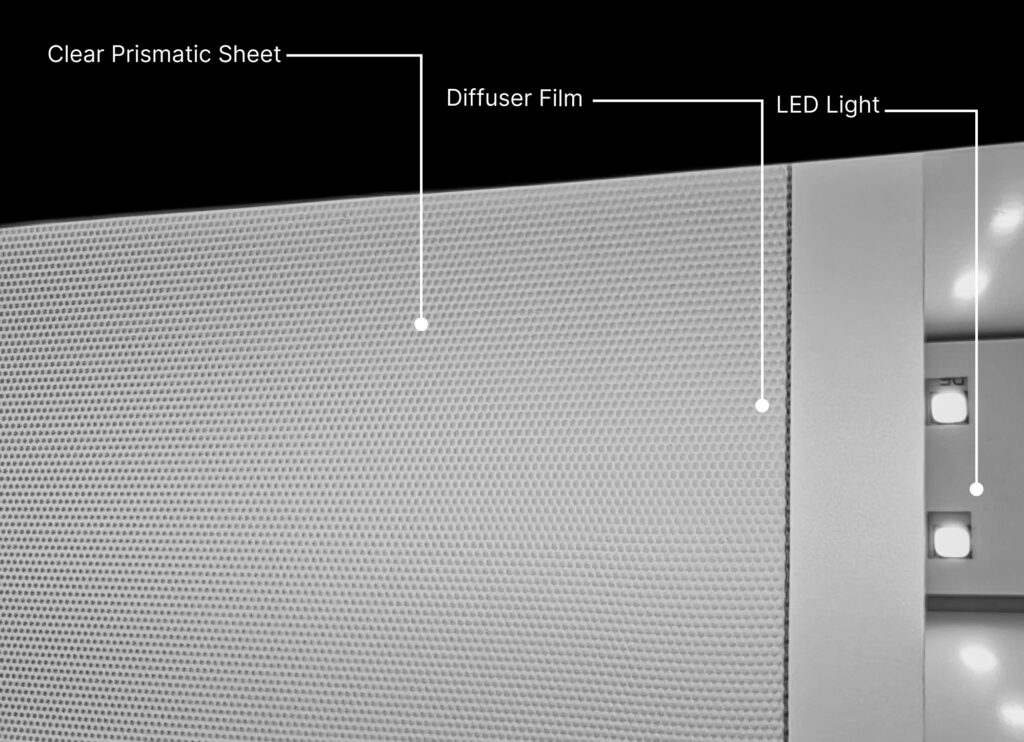
Para aplicaciones más robustas o exigentes, recomendamos las siguientes láminas difusoras translúcidas en espesores de 1,2 mm o 1,5 mm:
- Plexi90 Silk o Frost
- S92
- Poly80
Aplicaciones
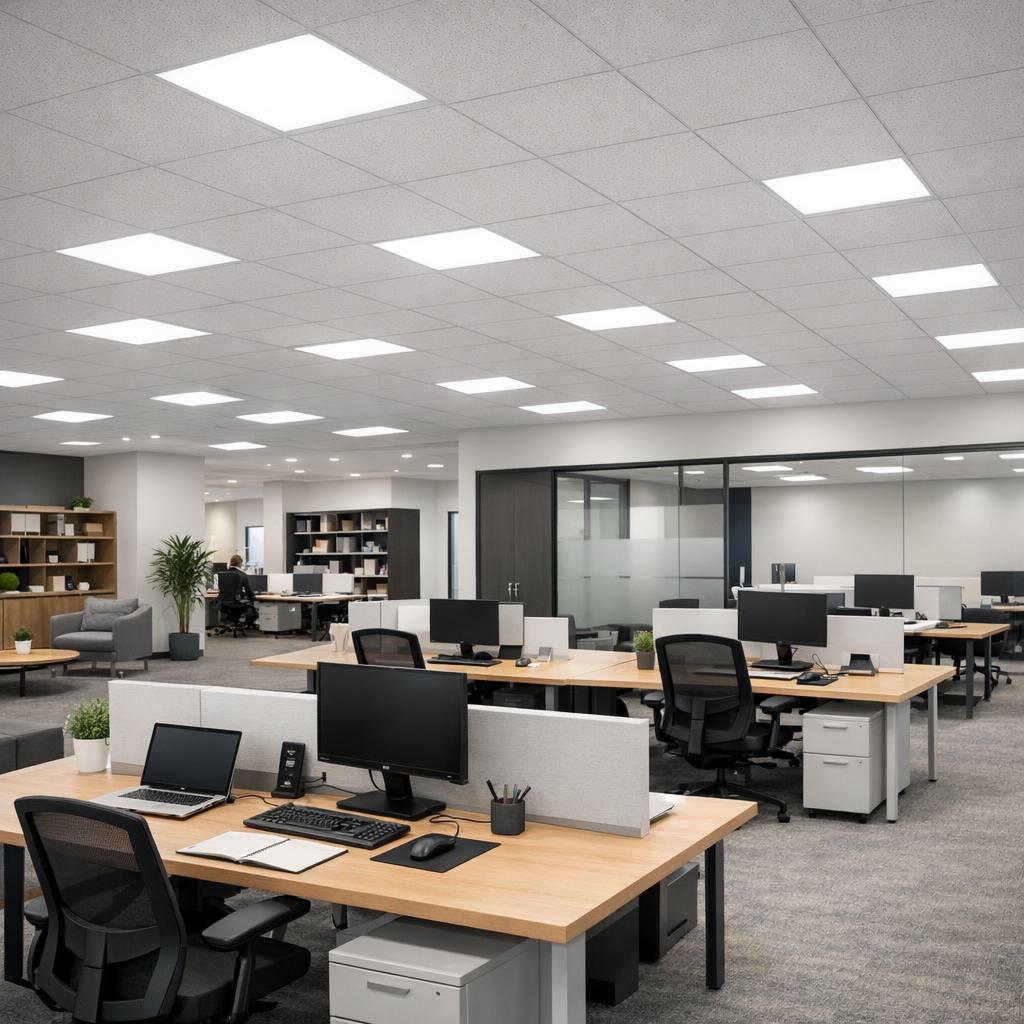
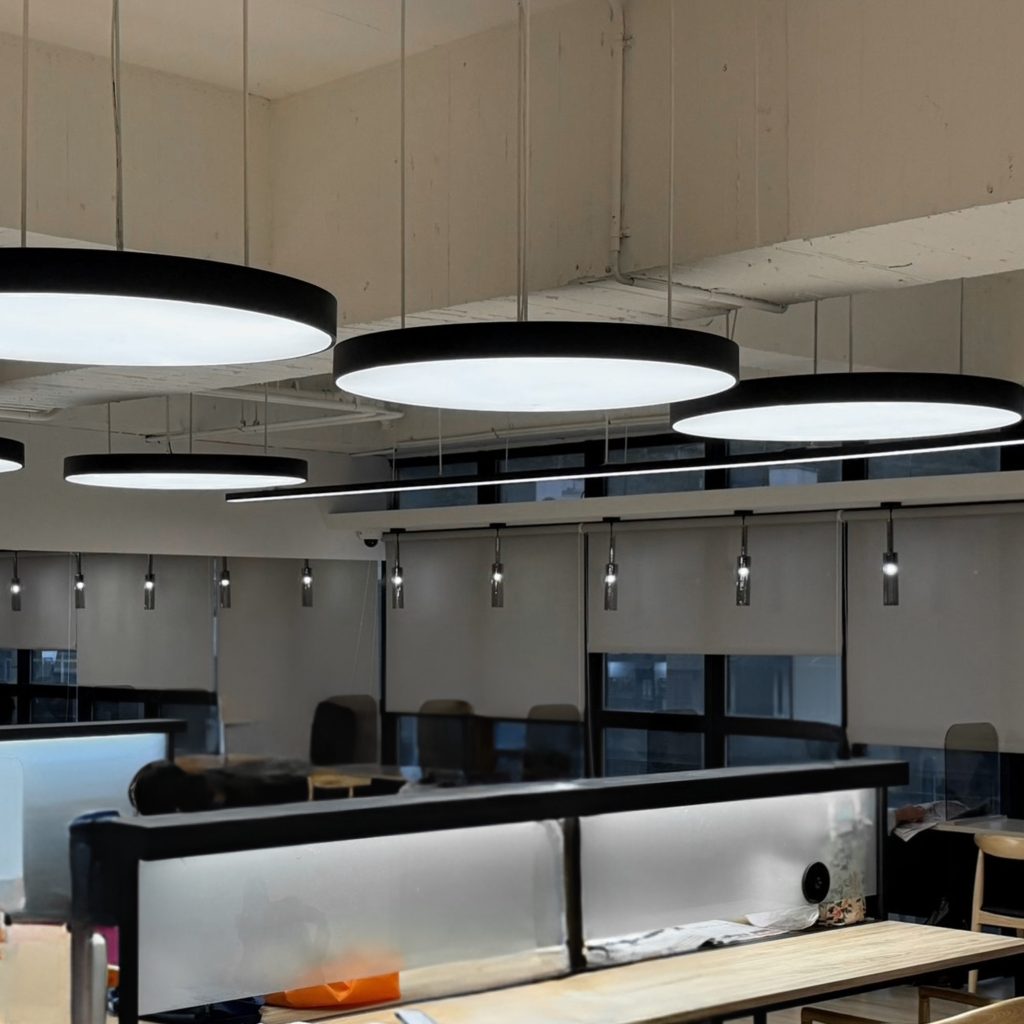
Más información
Aplicaciones de láminas UGR < 19
- Lugares de trabajo que requieren iluminación para tareas con pantallas (informática, estudios de diseño).
- Iluminación de oficinas (espacios abiertos, salas de reuniones).
- Colegios y universidades (aulas, bibliotecas, salas de estudio).
- Centros sanitarios (hospitales, clínicas, laboratorios).
- Edificios públicos (aeropuertos, museos, oficinas gubernamentales).
- Iluminación comercial (tiendas minoristas, centros comerciales).
- Iluminación arquitectónica (diseños de interiores modernos, espacios de coworking).
- Residencial de alta gama (cocinas, estudios, despachos domésticos).
Anchuras y longitudes disponibles
La anchura estándar de la lámina es de 1220 mm. Para proyectos especiales, la anchura de extrusión se puede ajustar hasta un máximo de 1250 mm bajo pedido.
Nuestras longitudes estándar son 1220 mm, 1830 mm, 2440 mm y 3050 mm. También se pueden fabricar longitudes personalizadas según sus necesidades.
Corte, mecanizado y fabricación a medida
Ofrecemos servicios completos de transformación para entregar las láminas prismáticas en el tamaño y acabado exactos que necesite:
Available options include:
- Fresado para crear escalones, ranuras o perfiles personalizados.
- Mecanizado CNC para formas y patrones precisos.
- Corte por láser para bordes suaves y geometrías complejas (hasta 1300×1300 mm).
- Corte por sierra para dimensionado estándar.
- Unión y ensamblaje de múltiples capas de láminas.
- Acabado de bordes con chaflanes, biseles y bordes redondeados.
Capacidad de corte por sierra: hasta 3050 mm de largo y >30 mm de ancho.
Tolerancias:
L: ±1 mm
W: +0,6 / -0 mm o +0 / -0,6 mm.
Materiales: Comparativa de PMMA, PC y PS
Use this comparison table to quickly understand the differences and find the best option for your lighting project.
| Propiedad / Característica | PMMA (Acrílico) | PC (Policarbonato) | PS (Poliestireno) |
| Transmisión de luz | Muy alta | Alta | Alta |
| Resistencia al impacto | Baja (frágil) | Muy alta (irrompible) | Baja (frágil) |
| Resist. térmica (uso cont.) | 80–90°C | 120°C | 70°C |
| Calor máx. a corto plazo | ~100°C | ~135°C | ~80°C |
| Resist. UV / Intemperie | Buena | Moderada (con estabilizador) | Regular (tiende a amarillear) |
| Inflamabilidad / Seguridad | Moderada (UL94 HB) | Mejor (UL94 V-2/V-0) | Moderada (UL94 HB) |
| Resistencia química | Buena | Excelente | Mala (sensible a disolventes) |
| Densidad | 1,18 g/cm³ | 1,2 g/cm³ | 1,05 g/cm³ |
| Procesamiento | Láser, CNC, Termoformado | CNC, Termoformado | CNC |
| Coste | Medio | Alto | Bajo |
| Aplicaciones comunes | Paneles LED oficina | Industria, exterior | Proyectos de bajo presupuesto |
Tolerancias del producto
The three materials (PMMA, PC and PS) have similar tolerances.
| Propiedad | Valor |
| Espesor | ±3% |
| Largo / Ancho (Plancha madre) | ±3,0 mm |
| Largo / Ancho (Corte a medida) | ±0,3 mm |
| Transmitancia y Haze | ±2% |
Nota: El PMMA tiene el coeficiente de expansión térmica más alto. Utilice nuestra Calculadora de Expansión Térmica para predecir las dimensiones finales antes de la instalación.
Embalaje
En Hexatron Technologies, ponemos mucho cuidado en el embalaje de nuestras láminas difusoras para garantizar que lleguen a nuestros clientes en perfectas condiciones
1. Standard Sheet Packing
- Mother Sheets: Large sheets (up to standard extrusion sizes) are stacked on pallets or crates.
- Final Cut / Cut-to-Size Sheets: Smaller sheets are carefully wrapped and separated with protective films or kraft paper, then bundled to avoid bending or warping.
2. Protection Methods
- Surface Protection Film: All diffuser sheets are supplied with a removable protective film to prevent scratches and contamination.
- Edge Guards / Corner Protectors: To prevent chipping or denting during handling and shipping.
3. Palletization & Securing
- Sheets are stacked on pallets or crates with interleaving layers and secured with straps or stretch film to prevent movement during transit.
- Maximum stack height is calculated based on sheet thickness and material to avoid warping or deformation. A pallet of 1.5 tons is the maximum weight.
4. Shipping & Handling Recommendations
- Flat Storage: Sheets should be stored flat and supported evenly to maintain flatness.
- Climate Considerations: Avoid prolonged exposure to extreme temperatures or humidity, especially for PMMA, to prevent dimensional changes.
- Handling: Use gloves when removing protective film to prevent fingerprints.